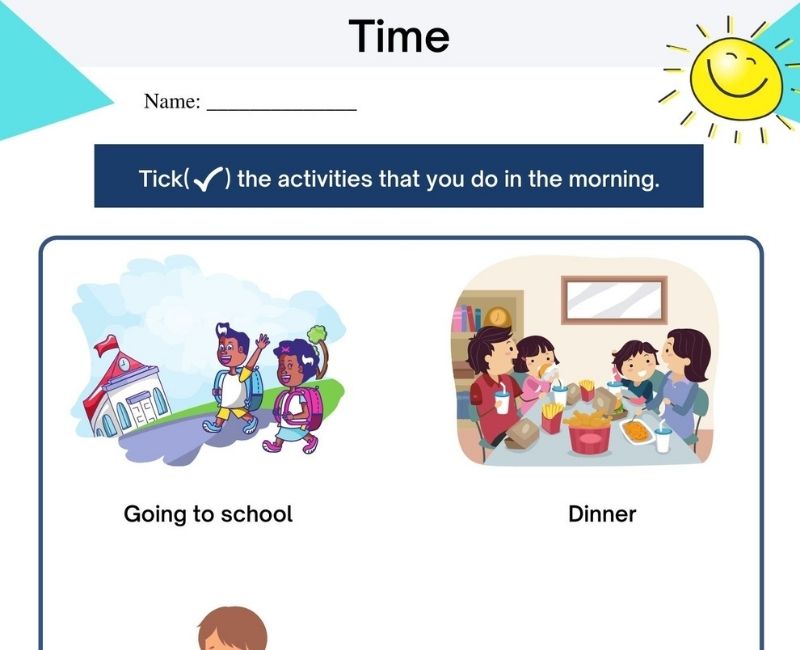
Time Worksheet for Class 1
What time does school begin? When is it time to play? Learning about time helps children connect clocks with familiar events and understand the order of their daily activities.
Use this time worksheet for Class 1 to support early clock-reading practice. The explanations and additional activities below introduce the hour hand, minute hand, o’clock and half past. Begin with whole hours, then explore half-hour times when your child can confidently recognise the clock hands.
Understanding the Hands of a Clock
An analogue clock usually has numbers from 1 to 12 arranged around its face. The shorter hand is the hour hand. The longer hand is the minute hand. Some clocks also have a second hand, but children can focus on the hour and minute hands for these activities.
Ask your child to identify each hand before reading the time. The hands move together: as the minute hand travels around the clock, the hour hand gradually moves towards the next hour. This is especially important when learning half past.
Telling Time to the Hour: O’clock
At an exact whole hour, the minute hand points to 12 and the hour hand points to the hour number. If the minute hand points to 12 and the hour hand points to 4, the time is four o’clock.
3:00 = three o’clock. The hour hand points to 3, and the minute hand points to 12.
8:00 = eight o’clock. The hour hand points to 8, and the minute hand points to 12.
Practise several different hours while keeping the minute hand at 12. Ask children to say the time aloud and write it in digital form.
Understanding Half Past
Half past means thirty minutes after an hour. The minute hand points to 6 because it has travelled halfway around the clock. The hour hand sits halfway between the hour just passed and the next hour.
At 2:30, the minute hand points to 6 and the hour hand is halfway between 2 and 3. Read this as “half past two.” At 7:30, the hour hand is halfway between 7 and 8, so the time is “half past seven.”
When drawing half-hour times, remind children that the hour hand should not point exactly to the hour number. It has already moved halfway towards the next number.
Match Clock Times with Daily Activities
Connect clock reading with your child’s actual routine. Choose familiar events, such as leaving for school, eating lunch or beginning an evening activity. Write down the times and show them on a clock model.
Talk about morning, afternoon, evening and night without assuming that every family follows the same schedule. Ask your child to arrange three familiar activities in the order they happen and describe what comes before or after each one.
A clock showing 7:00 does not tell us by itself whether it is morning or evening. The surrounding information helps us understand which part of the day is meant.
Extra Time Questions for Class 1 with Answers
Try these additional questions orally or in a notebook. Use a clock model for support. For drawing questions, make the hour hand shorter than the minute hand.
- Which hand is usually shorter: the hour hand or the minute hand?
- Where does the minute hand point at an o’clock time?
- The hour hand points to 5 and the minute hand points to 12. What time is it?
- Write nine o’clock in digital form.
- Write 11:00 in words.
- Where does the minute hand point at half past?
- Write half past four in digital form.
- Write 6:30 using the words “half past.”
- At half past eight, between which two numbers is the hour hand?
- Draw the hands to show 10:00.
- Draw the hands to show 3:30.
- What time is one hour after 2:00?
- What time is one hour before 6:00?
- On the same morning, which comes first: 8:00 or 9:00?
View answers to the extra practice questions
1. The hour hand; 2. At 12; 3. Five o’clock; 4. 9:00; 5. Eleven o’clock; 6. At 6; 7. 4:30; 8. Half past six; 9. Between 8 and 9; 10. Hour hand at 10 and minute hand at 12; 11. Hour hand halfway between 3 and 4 and minute hand at 6; 12. 3:00; 13. 5:00; 14. 8:00.
Make a Clock and Practise Together
Draw a large clock face on card, placing 12 at the top, 6 at the bottom, 3 on the right and 9 on the left. Add the remaining numbers in order. Use two paper hands of different lengths and attach them so they can move.
Show an o’clock time and ask your child to read it. Then say a time and let the child position the hands. When introducing half past, move both hands to their correct positions. Keep practice focused on a few examples and invite your child to explain how they recognised each time.
Related Time Resources and Class 1 Worksheets
Telling Time Worksheets for First Graders: Explore another resource for clock-reading practice. Time and Calendar Exercises for Class 1: Continue learning about clocks and calendars. Before and After Numbers Worksheet: Strengthen number order for understanding earlier and later hours. Addition and Subtraction Worksheets: Practise counting forwards and backwards. Browse Class 1 Maths Worksheets: Find more topics for regular practice.Frequently Asked Questions
How do I start teaching time to a Class 1 child?
Begin with daily events and their order. Introduce the clock numbers and identify the two main hands. Practise whole-hour times before moving to half past.
What does o’clock mean?
O’clock describes an exact whole hour, such as 4:00. On an analogue clock, the minute hand points to 12 and the hour hand points to 4.
Why does the minute hand point to 6 at half past?
A complete journey around the clock represents sixty minutes. Halfway around represents thirty minutes, so the minute hand reaches 6 at half past.
Where should the hour hand be at 5:30?
It should be halfway between 5 and 6. The minute hand points to 6. Together, these positions show half past five.
What is the difference between analogue and digital clocks?
An analogue clock shows time with hands moving around a clock face. A digital clock shows time with digits, such as 2:00 or 2:30. Children can practise matching the two representations.
Are answers available for the extra time questions?
Yes. Open the answer section beneath the extra questions in this description to check the corresponding answers and clock-hand positions.
 Download