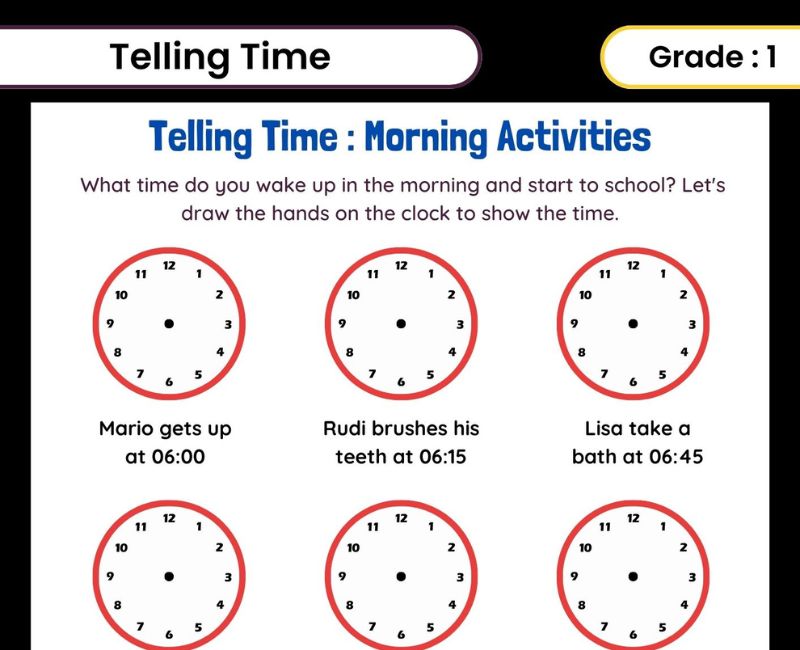
Telling Time Worksheets for Class 1
Reading a clock helps children understand when everyday activities happen. Use these telling time worksheets for Class 1 alongside a teaching clock to connect the position of the hands with the time shown. Encourage your child to read a time aloud, explain the hands and write the answer.
The guide below introduces whole hours and half hours through clear examples. It also includes additional practice questions with a click-to-open answer box and expandable FAQs. Use these activities alongside the worksheet download available on this page.
Start with the Two Clock Hands
Before asking children to read a clock, check that they recognise its numbers and can distinguish the hands. The shorter hand shows the hour. The longer hand shows the minutes. Both move clockwise around the face.
Hour hand: The shorter hand.
Minute hand: The longer hand.
One complete turn of the minute hand: 60 minutes, or one hour.
Ask your child to point to each hand and describe its job. If the clock has a second hand, explain that they can focus on the hour and minute hands for these beginner activities.
Reading Time to the Hour
At an o’clock time, the minute hand points to 12. The hour hand points directly to the hour number. Read that number and add “o’clock.” In digital form, the minutes are written as 00.
Worked example: 4 o’clock
The short hand points to 4 and the long hand points to 12.
Written time: 4:00
Practise several whole-hour times in a mixed order. When drawing the hands, start both at the centre and keep the hour hand visibly shorter than the minute hand.
Understanding Half Past
Half past means thirty minutes after an hour. The minute hand points to 6, halfway around the clock. The hour hand has also moved and sits halfway between the current hour and the next hour.
Worked example: half past 8
The long hand points to 6. The short hand is halfway between 8 and 9.
Written time: 8:30
Show the change from 8:00 to 8:30 using a teaching clock. This helps children see why the hour hand does not remain exactly on 8 at half past eight.
Connect Clock Hands with Digital Time
An analogue clock uses hands, while a digital clock displays numbers. In a time such as 6:30, the number before the colon shows the hour and the number after it shows the minutes.
6:00: Six o’clock.
6:30: Half past six.
Try both directions: show a clock and ask your child to write its time, then give a written time and ask them to set the hands. Check that they use both hands rather than reading only the hour hand.
Extra Clock-Reading Practice
These original questions provide additional practice. Answer orally, use a teaching clock or write your responses in a notebook.
- Which hand shows the minutes?
- The short hand points to 2 and the long hand points to 12. What time is it?
- Write nine o’clock in digital form.
- Read 11:00 in words.
- Where does the minute hand point at half past?
- Write half past four in digital form.
- Read 10:30 using “half past.”
- Where is the hour hand at 3:30?
- Where is the hour hand at 12:30?
- How many minutes are in half an hour?
- Describe the hand positions for 7:00.
- Describe the hand positions for 7:30.
Click to Show Practice Answers
1. The longer minute hand.
2. 2 o’clock, or 2:00.
3. 9:00.
4. Eleven o’clock.
5. At 6.
6. 4:30.
7. Half past ten.
8. Halfway between 3 and 4.
9. Halfway between 12 and 1.
10. 30 minutes.
11. Short hand at 7; long hand at 12.
12. Short hand halfway between 7 and 8; long hand at 6.
Make Time Practice Part of Everyday Learning
Choose a familiar activity and discuss its actual time, such as leaving home or beginning a lesson. Show that time on a clock when it matches the level your child is practising. Avoid assigning the same routine times to every family.
Keep practice short and varied. Read a clock, set a time and draw the hands. If your child makes a mistake, ask them to identify the minute hand first and explain its position. Remember that a clock showing 7:00 alone does not tell us whether it is morning or evening; the context supplies that information.
Explore Related Worksheets
Time Worksheet for Class 1Explore another time resource for additional practice. How Do I Spend My Day? Worksheet
Connect time with daily activities through this separate textbook resource. Numbers 1 to 20 Worksheet
Strengthen number recognition before reading clock faces. Skip Counting Worksheets
Practise counting in equal steps for later work with clock minutes. Browse All Class 1 Maths Worksheets
Find more activities for numbers, operations, shapes and measurement. **Page title / Meta title:** Telling Time Worksheets for Class 1 **Meta description:** Help children practise reading clocks with telling time worksheets for Class 1, clear explanations, extra questions and clickable answers for checking. ```html
Telling Time Worksheets for Class 1
Learning to read a clock helps children understand when familiar activities happen. Use these telling time worksheets for Class 1 alongside a teaching clock to practise recognising the hands, observing their positions and recording the time.
Start with the worksheet instructions and support your child at their current level. The additional guide below introduces whole hours and half hours through worked examples, a practical clock activity and original questions. Open the answer box after attempting the practice, and click each FAQ to read its explanation.
Look at the Clock Before Reading the Time
Ask your child to find 12 at the top of the clock, 6 at the bottom, 3 on the right and 9 on the left. Then follow the numbers around the face in a clockwise direction. Recognising these positions makes it easier to describe where a hand is pointing.
Hour hand: The shorter hand shows the hour.
Minute hand: The longer hand shows the minutes.
Practise identifying the hands separately before asking for a complete time. If the clock also has a second hand, explain that beginners can concentrate on the hour and minute hands for these activities.
Reading Whole Hours: O’clock
At an exact hour, the long minute hand points to 12. The short hour hand points to the hour number. Read that number and say “o’clock.”
Worked example: 4 o’clock
The short hand points to 4 and the long hand points to 12. The time is four o’clock, written as 4:00.
Try reading a time and then setting it on a movable clock. Reverse the task by setting the hands yourself and asking your child to read them. This checks whether they can connect spoken time, written time and hand positions.
Introducing Half Past
Introduce half hours when your child understands whole hours. Half past means thirty minutes after an hour. The minute hand points to 6, while the hour hand is halfway between the hour that has passed and the next hour.
Worked example: half past 8
The long hand points to 6. The short hand is halfway between 8 and 9. The time is 8:30.
Show that the hour hand moves gradually. At 8:30, it has moved beyond 8 but has not reached 9. When drawing the hands, place the short hand between the numbers rather than directly on 8.
Connecting Clock Hands with Digital Time
An analogue clock uses hands, while a digital clock displays numbers. In a time such as 6:30, the number before the colon shows the hour and the number after it shows the minutes.
6:00: Six o’clock.
6:30: Half past six.
Make matching cards with written times and clock drawings. Ask your child to pair them and explain both hand positions. Keep the selection small at first so they can focus on understanding each match.
Extra Clock-Reading Practice
These original questions provide additional practice alongside the downloadable worksheet. Answer aloud, write in a notebook or demonstrate the time on a teaching clock.
- Which hand shows the hour?
- Where does the minute hand point at an exact hour?
- The short hand points to 2 and the long hand points to 12. What time is it?
- Write nine o’clock in digital form.
- Describe the hand positions for 11:00.
- Where does the minute hand point at half past?
- Write half past four in digital form.
- Read 7:30 using the words “half past.”
- Where should the hour hand be at 3:30?
- How many minutes are in half an hour?
- Describe the hand positions for 12:30.
- Can a clock showing 8:00 alone tell you whether it is morning or evening?
Click to View Practice Answers
- The shorter hour hand.
- At 12.
- Two o’clock, or 2:00.
- 9:00.
- Short hand at 11; long hand at 12.
- At 6.
- 4:30.
- Half past seven.
- Halfway between 3 and 4.
- 30 minutes.
- Short hand halfway between 12 and 1; long hand at 6.
- No. You need information about the situation or an AM/PM indication.
Make Time Practice Part of Everyday Learning
Choose a familiar event and show its actual time on a teaching clock. Ask your child to read it, write it and describe the hands. Use your own routine rather than assuming every child eats, studies or sleeps at the same time.
If your child confuses the hands, return to identifying their lengths. If they read 5:30 as 6:30, show that the short hand has not reached 6 yet. A few carefully discussed examples can reveal more than a long page completed without explanation.
Explore Related Worksheets
Time Worksheet for Class 1Continue practising time concepts with another worksheet resource. How Do I Spend My Day? Worksheet
Explore the NCERT chapter resource about time and daily activities. Skip Counting Worksheets for Class 1
Build counting-in-fives skills for later work with clock minutes. Browse All Class 1 Maths Worksheets
Find more activities for numbers, operations, shapes and measurement.
Frequently Asked Questions
How should I introduce telling time to Class 1?
Begin with clock numbers and identifying the hands. Practise whole hours on a movable clock, then introduce half hours when your child is ready.
Why does the minute hand point to 12 at o’clock?
The top position marks zero minutes past the hour. At 3:00, the minute hand points to 12 and the hour hand points to 3.
What does half past mean?
It means thirty minutes after an hour. Half past two is 2:30, with the minute hand at 6.
Does the hour hand move between hour numbers?
Yes. It moves gradually throughout the hour. At 2:30, it is halfway between 2 and 3.
How can I help my child draw clock hands correctly?
Start both hands at the centre. Draw a shorter hour hand and a longer minute hand. Check their positions on a teaching clock before drawing.
Where can I check the extra practice answers?
Click “View Practice Answers” below the twelve additional questions. The answers relate to those on-page questions.
 Download