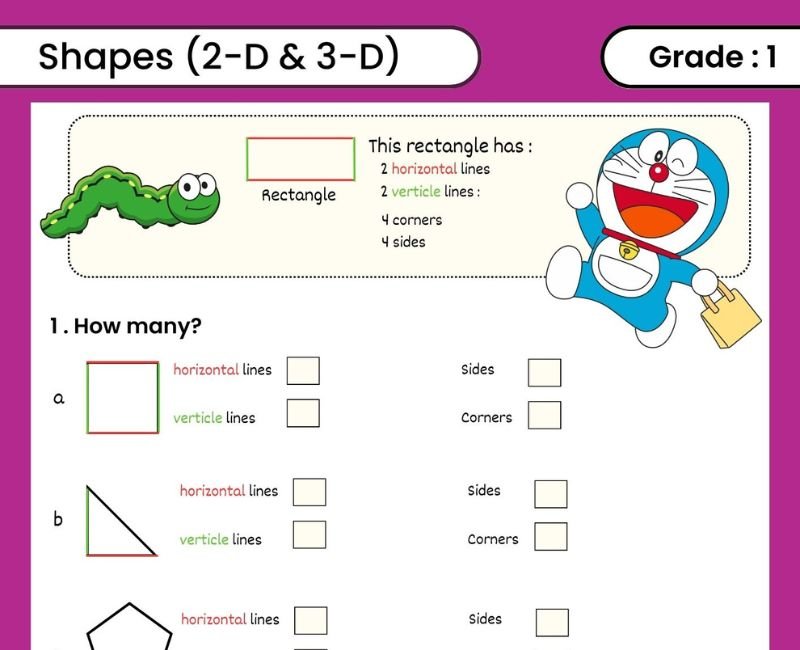
Shapes Worksheet for Class 1
What makes a triangle different from a square? Is a ball the same shape as a circle? Learning about shapes helps children describe what they see, compare features and recognise familiar forms in everyday objects.
Use this shapes worksheet for Class 1 to support early geometry learning. The explanations and additional activities below explore 2D and 3D shapes, shape names, straight sides, corners and everyday examples. Begin with recognising and matching shapes, then encourage children to explain the features that helped them identify each one.
Understanding 2D Shapes
Two-dimensional shapes are flat mathematical shapes. A circle drawn on paper and a square outline are examples of 2D shapes. We describe them using features such as straight sides, curved boundaries and corners.
Circle: A round shape with a curved boundary, no straight sides and no corners.
Triangle: A closed shape with three straight sides and three corners.
Square: A shape with four equal straight sides and four right-angle corners.
Rectangle: A shape with four straight sides and four right-angle corners. Opposite sides are equal in length. A square is a special rectangle with all four sides equal.
Oval: In early shape activities, an oval is usually shown as a rounded, stretched shape with no corners.
Count Straight Sides and Corners Carefully
A straight side is part of a shape’s boundary. A corner is a point where two straight sides meet. Show children how to trace around a triangle, count its three sides and then point to its three corners.
Mark the starting point so children do not count a side or corner twice. Use “straight sides” when comparing polygons with circles. This avoids confusion about whether a curved boundary should be called a side.
A Shape Stays the Same When Turned
A triangle can point upwards, downwards or sideways and still be a triangle. Its three straight sides and three corners remain the same. A square turned onto a corner is still a square.
Show shapes in different sizes, colours and orientations. Ask children to match them by their mathematical features rather than appearance alone. A small blue circle and a large yellow circle belong to the same shape group.
Introducing 3D Shapes with Everyday Objects
Three-dimensional shapes have length, width and height. They describe solid forms, such as a cube or sphere. Use familiar objects as models, while explaining that real objects may only approximately match a mathematical shape.
Sphere: A ball is a familiar model of a sphere. It has a curved surface and no flat faces.
Cube: A cube-shaped block has six square faces, all the same size.
Cuboid: A rectangular box is a familiar model of a cuboid, which has six rectangular faces.
Cylinder: A cylindrical tin has two flat circular faces and a curved surface between them.
Cone: A mathematical cone has a circular base, a curved surface and a pointed top. A party hat suggests its form, although the hat is usually open at the bottom.
The Difference Between a Circle and a Sphere
A circle is a flat shape; a sphere is a solid shape. A drawing of a circle does not have the same three-dimensional form as a ball. Similarly, a square is a flat shape, while a cube is a solid with square faces.
Ask children to name an object and then describe a face or outline separately. For example, a cylindrical tin is a solid object, and its flat end is circular. This connects 2D and 3D shapes without treating them as interchangeable.
Extra Shapes Questions for Class 1 with Answers
Try these additional online questions orally or in a notebook. Use shape drawings and solid models to support your answers.
- Which 2D shape has three straight sides?
- How many corners does a triangle have?
- Which shape has four equal straight sides and four right-angle corners?
- How many straight sides does a rectangle have?
- Does a circle have corners?
- Is a square still a square after it is turned?
- Are a large triangle and a small triangle the same type of shape?
- Which solid shape does a ball resemble?
- Which solid shape has six equal square faces?
- What is the shape of a cylindrical tin’s flat end?
- Is a circle a 2D shape or a 3D shape?
- Is a cube a 2D shape or a 3D shape?
- Draw a triangle and mark its corners.
- Find an object with a rectangular face and name it.
View answers to the extra practice questions
1. Triangle; 2. Three; 3. Square; 4. Four; 5. No; 6. Yes; 7. Yes; 8. Sphere; 9. Cube; 10. Circle; 11. 2D; 12. 3D; 13. A closed figure with three straight sides and three marked corners; 14. Answers vary, such as a book or rectangular box.
Shape Sorting and a Classroom Shape Hunt
Prepare shape cards in different colours, sizes and orientations. Ask children to sort by shape, then explain their choices. Change the rule and sort by colour to show that the same cards can be grouped in different ways.
For a shape hunt, look for circular outlines, rectangular faces and solid forms around the room. Ask, “Are we describing the whole object or just one face?” Follow up by drawing a familiar object and labelling the shape feature your child noticed.
Related Class 1 Maths Worksheets
Shapes and Space Worksheet: Explore shape matching, positions, rolling and sliding. Patterns Worksheet: Use shapes to identify and continue repeating arrangements. Measurement Worksheet: Compare lengths and heights while describing objects precisely. Ordinal Numbers Worksheet: Identify the positions of shapes and objects in a row. Browse Class 1 Maths Worksheets: Find more activities for regular practice.Frequently Asked Questions
How do I teach shapes to a Class 1 child?
Start with clear examples of circles, triangles, squares and rectangles. Name each shape, explore its features and match it with other examples before introducing solid shapes.
What is the difference between 2D and 3D shapes?
A 2D shape is flat and has two dimensions. A 3D shape has three dimensions and describes a solid form. A circle and sphere provide a useful comparison.
Can a triangle have sides of different lengths?
Yes. A triangle needs three straight sides forming a closed shape. Its sides do not all have to be equal.
Is a square also a rectangle?
Yes. A square meets the rectangle’s requirement of four right-angle corners. It has the additional feature that all four sides are equal.
Why should children see shapes in different orientations?
It helps them recognise a shape by its features rather than memorising one picture. Turning a shape changes its orientation without changing its identity.
Are answers available for the extra shape questions?
Yes. Open the answer section below the additional questions in this description to check their corresponding answers.
 Download