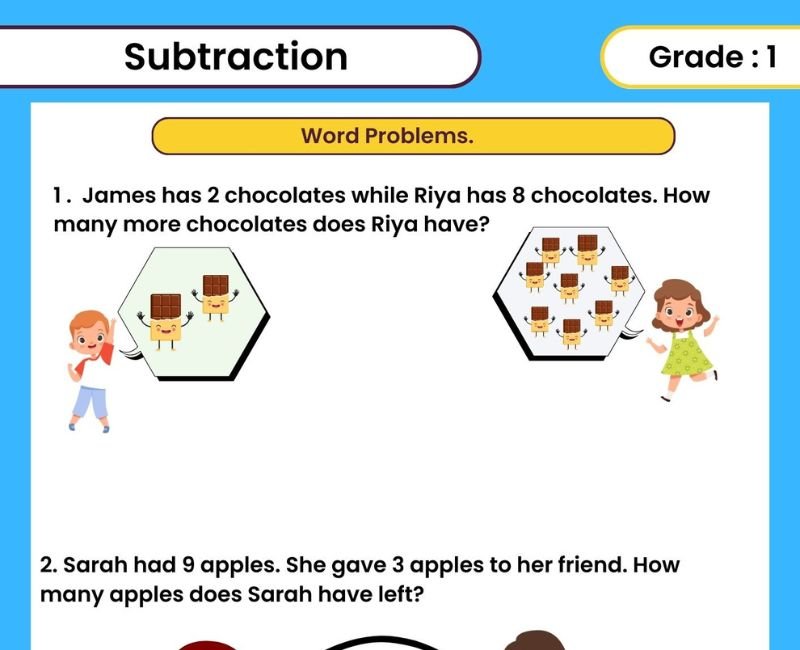
Subtraction Word Problems Worksheet for Class 1
Turn everyday situations into maths practice with this subtraction word problems worksheet for Class 1. Children read a short story, understand what happens to the quantities and work out the answer. Stories about pencils, toys, books and fruit help connect subtraction with familiar experiences.
Use this resource for classroom practice, homework or revision. Support children with counters, simple drawings or a number line before asking them to write a subtraction sentence. The worked examples and extra subtraction story sums below help them explain their thinking and check their answers.
What Is a Subtraction Word Problem?
A subtraction word problem presents a situation in words instead of giving only a calculation. Children must decide what the numbers represent and what the question asks them to find. Subtraction can help find an amount left after taking something away, a missing part of a total or the difference between two quantities.
Example: There are 8 apples in a basket. Three apples are eaten. How many apples are left?
Number sentence: 8 - 3 = 5
Answer: 5 apples are left.
How to Solve Subtraction Story Sums
- Read the story: Ask what is happening and let your child retell it in their own words.
- Identify the quantities: Explain what each number counts.
- Find the question: Decide whether you need the amount left, a missing part or the difference.
- Show the situation: Use objects, drawings or a number line to represent it.
- Calculate and answer: Write the subtraction sentence and include what the answer counts.
Words such as “left” and “fewer” can help children understand a story, but they should read the whole problem before choosing an operation. Understanding the situation is more reliable than looking for one particular word.
Worked Example: Finding How Many Are Left
Story: Meera has 12 crayons. She gives 4 crayons to her brother. How many crayons does Meera have left?
Start with twelve counters to represent the crayons. Move four counters away because those crayons were given to her brother. Count the eight counters that remain.
12 - 4 = 8
Meera has 8 crayons left.
Check: 8 crayons left + 4 crayons given away = 12 crayons.
Worked Example: Comparing Two Quantities
Story: Aarav has 9 toy cars. Kabir has 6 toy cars. How many more toy cars does Aarav have than Kabir?
Draw nine circles in one row and six circles in another row, lining them up in pairs. Six cars in each collection can be matched. Three cars in Aarav's collection remain unmatched.
9 - 6 = 3
Aarav has 3 more toy cars than Kabir.
Although the question uses the word “more,” subtraction finds the difference between the two collections. This is why children need to understand the complete story.
Extra Subtraction Word Problems for Class 1 with Answers
Try these additional story sums using numbers within 20. Write a number sentence and a short answer for each question.
- Riya has 7 balloons. Two balloons burst. How many balloons are left?
- There are 10 birds on a fence. Four fly away. How many birds remain?
- A basket contains 13 oranges. Five are used to make juice. How many oranges remain?
- Dev has 15 stickers. He gives 6 to a friend. How many stickers does he have left?
- There are 8 biscuits on a plate. All 8 are eaten. How many biscuits are left?
- A shelf has 18 books. Seven books are borrowed. How many books remain on the shelf?
- Anaya has 12 beads. Tara has 8 beads. How many more beads does Anaya have?
- There are 9 red blocks and 5 green blocks. How many fewer green blocks are there than red blocks?
- A box contains 14 pencils. Nine are sharpened and the rest are unsharpened. How many pencils are unsharpened?
- There are 16 children in a group. Ten wear caps. How many children do not wear caps?
- A shop has 20 notebooks. Eight are sold. How many notebooks are left?
- A tray has space for 10 cups. Six cups are already on it. How many more cups are needed to fill the tray?
Answers:
1. 7 - 2 = 5 balloons; 2. 10 - 4 = 6 birds; 3. 13 - 5 = 8 oranges; 4. 15 - 6 = 9 stickers; 5. 8 - 8 = 0 biscuits; 6. 18 - 7 = 11 books; 7. 12 - 8 = 4 more beads; 8. 9 - 5 = 4 fewer green blocks; 9. 14 - 9 = 5 unsharpened pencils; 10. 16 - 10 = 6 children; 11. 20 - 8 = 12 notebooks; 12. 10 - 6 = 4 cups.
Helping Children Understand and Check Their Answers
If reading is difficult, read the problem aloud without choosing the operation for your child. Ask them to act out the situation with counters or draw a simple picture. This helps you distinguish a reading difficulty from a maths difficulty.
Check whether the answer makes sense in the story. When some objects are taken away, the amount left cannot be greater than the starting amount. When comparing two groups, the answer tells the difference rather than the combined total.
Use addition to check a subtraction answer. For 13 - 5 = 8, adding 8 and 5 gives the original total of 13. Encourage children to include the correct unit, such as “8 oranges,” so their answer responds to the question.
Explore Related Class 1 Maths Worksheets
Addition Word Problems Worksheet for Class 1Practise story sums involving joining quantities and finding totals. Subtraction Worksheets for Class 1
Strengthen calculation skills alongside word problem practice. Missing Number Subtraction Worksheet
Explore missing values in subtraction number sentences. Addition and Subtraction Worksheets for Class 1
Practise both operations and connect related number facts. Browse All Class 1 Maths Worksheets
Find more activities for counting, place value, shapes and measurement.
Frequently Asked Questions
What are subtraction story sums?
They are short situations that can be solved using subtraction, such as finding how many objects remain, identifying a missing part or comparing two quantities.
How do I explain subtraction word problems to Class 1?
Read the story together, act it out with objects and identify what the question asks. Then connect the model with a subtraction sentence and a short written answer.
Does “how many more” always mean addition?
No. When comparing two known quantities, “how many more” asks for their difference. For example, comparing 9 toys with 6 toys gives 9 - 6 = 3 more toys.
Can children use pictures to solve subtraction problems?
Yes. They can draw objects and cross out those taken away, or draw two aligned rows to compare quantities. The picture should match the story.
How can children check a subtraction answer?
Use the related addition fact. If 12 - 4 = 8, check that 8 + 4 = 12. Also check whether the answer fits the situation.
Are answers provided for the extra story sums?
Yes. The twelve additional questions on this page include subtraction sentences and answers for checking.
 Download