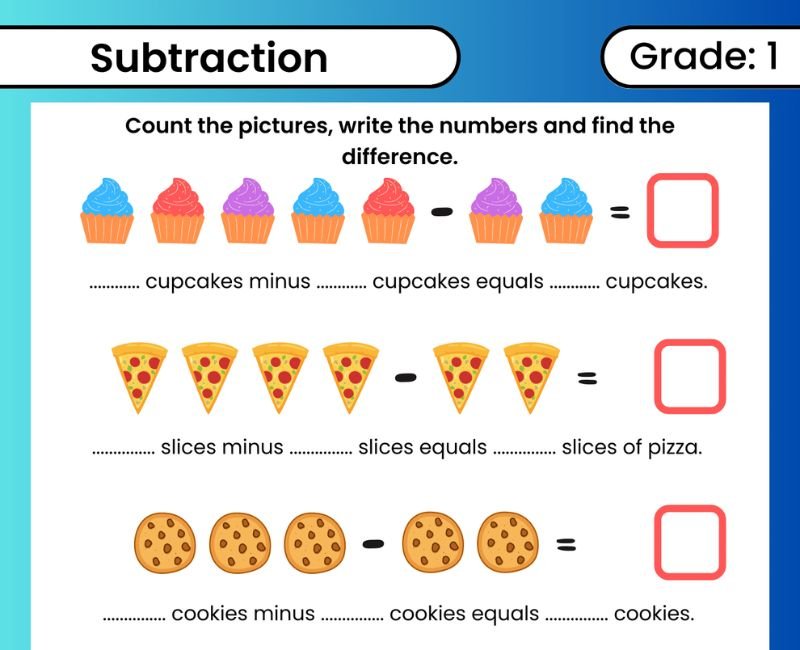
Printable Subtraction Worksheets for Class 1
A child may know that subtraction means taking away but still need help connecting a picture, a number line and a written sum. Varied practice lets children explore the same calculation in different ways and explain how they found the answer.
Use this printable subtraction worksheet collection for Class 1 for classroom learning, homework or revision. The activities described on this page include picture subtraction, one- and two-digit sums, number lines and colouring practice. The worked examples and extra questions below provide further support alongside the downloadable resource.
Start with a Clear Subtraction Sentence
In 8 - 3 = 5, eight is the starting quantity, three is the quantity removed and five is the quantity remaining. Read the sentence as “eight minus three equals five.” Show each part with counters before moving to written practice.
The equal sign tells us that both sides have the same value. Ask children to read the completed sentence and check it with their objects or drawing. This helps them connect the answer with the subtraction action.
Subtraction with Pictures: Cross Out and Count
Picture subtraction makes the quantities visible. Count the starting group, cross out the number being removed and count the pictures that remain. Encourage children to make clear marks and count each remaining picture once.
Worked example: Draw nine circles. Cross out four circles. Five circles remain, so 9 - 4 = 5.
Check the picture before checking the answer. If the child started with the wrong number of circles or crossed out too many, correct the representation together and count again.
Number-Line Subtraction and Counting Backwards
On a number line with values increasing from left to right, subtract by moving left. To solve 12 - 3, start at twelve and make three jumps: eleven, ten, nine. The answer is nine.
The starting position is not the first jump. Mark the starting number, then count each movement. This is useful when a child gives an answer that is one too large because they included the starting number in their backward count.
One-Digit and Two-Digit Subtraction Practice
Begin with small subtraction facts that children can show using objects. Examples such as 7 - 2 and 9 - 5 help them practise the meaning of subtraction and become familiar with written sums.
For two-digit subtraction without regrouping, use tens and ones. In 36 - 14, subtract four ones from six ones to get two ones. Subtract one ten from three tens to get two tens. The answer is 22.
If writing vertically, align ones below ones and tens below tens. Use bundles of ten sticks and individual sticks to explain place value. Introduce more demanding calculations only when the child understands the quantities involved.
Choose a Method That Fits the Sum
Counting backwards is convenient when subtracting a small number. For 15 - 2, two backward steps give thirteen. When the numbers are close together, finding the gap can be simpler.
For 15 - 13, count from thirteen to fifteen: fourteen, fifteen. The gap is two. Use a number line to show the two steps between the numbers.
Related addition facts provide another check. If 13 + 2 = 15, then 15 - 13 = 2. Encourage children to explain their chosen method rather than use one procedure for every question.
Extra Subtraction Questions with Answers
These additional online questions progress from small facts to simple two-digit subtraction without regrouping. Use pictures, counters or a number line where needed.
- 6 - 2 = ___.
- 9 - 5 = ___.
- 8 - 0 = ___.
- 7 - 7 = ___.
- 12 - 3 = ___.
- 15 - 2 = ___.
- 15 - 13 = ___.
- 18 - 6 = ___.
- 20 - 10 = ___.
- 28 - 5 = ___.
- 36 - 14 = ___.
- 47 - 23 = ___.
- A tray holds 14 cups. Four are removed. How many cups remain?
- One box holds 12 crayons and another holds 9. How many more crayons does the first box hold?
View answers to the extra practice questions
1. 4; 2. 4; 3. 8; 4. 0; 5. 9; 6. 13; 7. 2; 8. 12; 9. 10; 10. 23; 11. 22; 12. 24; 13. 10 cups, because 14 - 4 = 10; 14. 3 more crayons, because 12 - 9 = 3.
Subtraction Matching and Colouring Activities
Create matching cards with one subtraction sum on each card and its answer on a separate card. Begin with sums that have different answers so every match is clear. Ask the child to solve each sum before finding its answer card.
For a colouring activity, write sums inside drawn sections and provide an answer-based colour key. For example, colour answers of four green and answers of six purple. Check the calculation before colouring each section.
Choose Your Next Class 1 Maths Resource
Introductory Subtraction Worksheet: Revisit taking away and finding what remains. Missing Number Subtraction Worksheet: Find an unknown starting number, removed quantity or result. Printable Addition Worksheets: Build the addition facts used to check subtraction. Mixed Addition and Subtraction Worksheets: Practise reading operation signs carefully. Tens and Ones Worksheet: Strengthen place value before two-digit subtraction. Browse Class 1 Maths Worksheets: Explore more topics for regular practice.Frequently Asked Questions
Which subtraction activities should a beginner try first?
Begin with small groups of objects and picture subtraction. Introduce written sums alongside the action, then explore counting backwards and number lines.
What is subtraction without borrowing or regrouping?
It means the subtraction can be completed in each place-value column without exchanging a ten for ten ones. For example, 36 - 14 can be solved directly using its tens and ones.
When is counting the gap useful?
It can be useful when the two numbers are close together. For 14 - 12, counting from twelve to fourteen gives a gap of two.
Can the order of numbers be changed in subtraction?
Changing the order generally changes the result. Keep the starting number and the number being subtracted in their correct positions. Demonstrate this with a take-away story.
How can I check a subtraction answer using addition?
Add the answer to the number that was subtracted. For 18 - 6 = 12, check that 12 + 6 = 18.
Are answers provided for the extra online questions?
Yes. Open the answer section below the additional practice questions in this description. These answers correspond to the questions listed there.
 Download