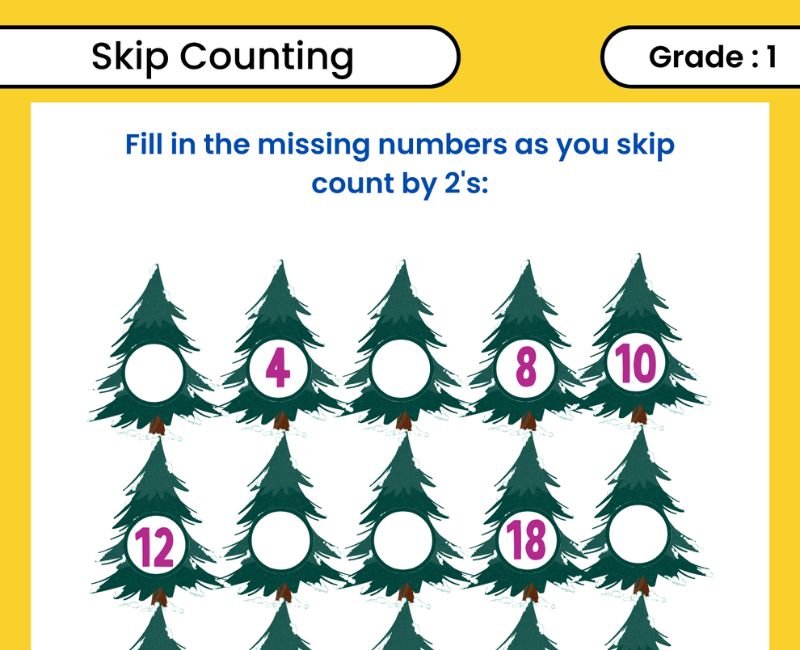
Equal Jumps, Clever Groups and Counting Adventures! 🌈
Explore skip counting worksheets for Class 1 with an online quiz, ten interactive games and activities, and five practice sets. Count in 2s, 5s and 10s, then try supported challenges in 3s and 7s.
📝 Skip Counting Online Quiz for Class 1
Question 1 of 20 • Answered: 0/20
14 → 16 → 18 → ?
A counter moves through 14, 16, 18 by adding two. Where does it land next?
🎮 Skip Counting Online Games for Class 1
Make equal robot jumps, pack groups of five, build a ten-step train, repair a bridge and fix a seven-step trail.
1. 🤖 Four Equal Robot Jumps
Start at 6. Use jumps of TWO to reach 14 in exactly four jumps.
Jumps: 0 • Position: 6
Ready to play!
2. 📦 Pack Four Groups of Five
Add crates containing exactly five counters each. Stop when there are FOUR crates, then record the object total.
Crates: 0
Ready to play!
3. 🚂 Build a Ten-Step Train
Start with 15 and arrange all six tickets so each next ticket is ten more.
🚂 Empty train
Ready to play!
4. 🌉 Repair the Three-Step Bridge
The bridge rule is +3: 31, □, 37, □. Write the two missing landings.
Ready to play!
5. 🔧 Fix the Seven-Step Trail
The rule is add seven: 14, 21, 29, 35. Edit the incorrect third landing.
Ready to play!
🧠 Skip Counting Online Activities for Class 1
Repair unequal groups, jump backwards, follow a counting maze, programme equal steps and build a personal counting strip.
6. ⚖️ Make Every Group a Pair
One group has an extra counter. Tap counters to mark them removed or restore them. Leave FOUR groups of TWO, then write the total remaining.
Ready to play!
7. 🦘 Jump Back in Fives
Begin at 50. Make equal backward jumps of five until you reach 20.
Backward jumps: 0 • Position: 50
Ready to play!
8. 🧭 Find the Five-Step Maze
Start at 2. Move to a side-neighbour worth five more each time. Finish at 32.
Ready to play!
9. ⚙️ Programme Three Equal Steps
Start at 8 and finish at 38 in exactly THREE equal forward jumps. Set one step size, then run the programme.
Ready to play!
10. 🎨 Create a Counting Challenge
Choose a start and step. Build four equal jumps with the last landing hidden. Solve your own strip or let a partner solve it.
Build a strip.
Ready to play!
✏️ Skip Counting Practice for Class 1
1. 🔎 Explore Equal Steps
Choose a step to view five equal jumps from zero. Compare the number of jumps with the final value.
Five jumps of 2 finish at 10.
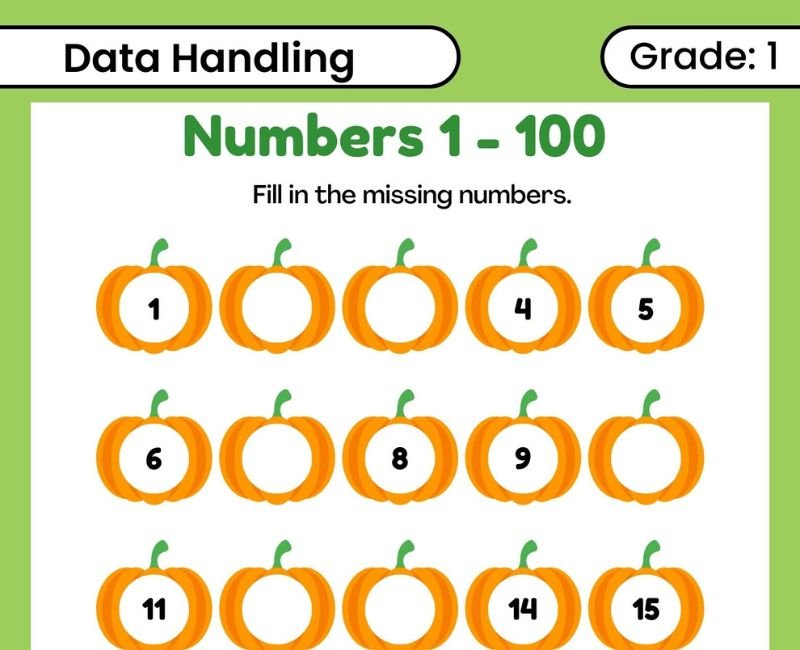
2. ✏️ Complete Three Counting Strips
Use the stated rule for each missing number.
Ready to explore.
3. 🧠 Separate Groups and Objects
Five equal groups contain three counters each. Record the number of groups and the total number of counters.
●●● | ●●● | ●●● | ●●● | ●●●
Ready to explore.
4. 🔙 Count Backwards by Two
Start at 19 and make three backward jumps of two. Write the final position.
19 → 17 → 15 → □
Ready to explore.
5. 📝 Plan a Real-Object Pattern
Choose a group size and number of groups. Generate a plan to build with counters, beads or blocks. This is open practice.
Choose a plan.
Ready to explore.
💡 Skip Counting Learning Tips
👩🏫 Five Parent and Teacher Tips
- Begin with equal groups of real objects.
- Use one step size at a time.
- Say the running total as each new group is counted.
- Separate the number of groups from the number of objects.
- Introduce threes and sevens gradually with visual support.
🌟 Six Tips for Students
- Check the starting number.
- Read the step size.
- Keep every jump equal.
- Check whether you move forwards or backwards.
- Count the jumps separately from the starting position.
- Use objects or a number line to check a tricky step.
📄 Skip Counting Worksheets for Class 1
📖 Read the Skip Counting Learning Guide
🐾 Count equal groups efficiently
Skip counting means moving through numbers in equal steps. Instead of counting every object separately, children can count the totals of equal groups. Two wheels on each bicycle make counting in twos useful; groups of five counters support fives. Ask the child to explain what is added each time.
🔟 Connect groups and place value
Skip counting by 10 links complete groups of ten with the tens-and-ones system. Adding ten to a two-digit number increases its tens count while preserving its ones digit, within the chosen range. Counting by 5 and 2 offers other useful patterns. Practise a short sequence, then check the totals with objects.
🦘 Read the start, step and direction
A counting rule needs a starting value and a step. Starting at four and adding five produces 4, 9, 14 and 19. Starting at zero with the same step produces different landings. On a number line, count the spaces crossed by each jump. The starting point is a position, not an extra jump.
🧩 Extend with support
This worksheet topic includes counting in 2s, 3s, 5s, 7s and 10s. Introduce unfamiliar steps using equal groups and repeated addition. Backward counting uses equal subtraction steps. Repairing an incorrect term or comparing two routes can reveal whether a child understands the rule beyond reciting a memorised sequence.
✏️ Bring the pattern onto paper
Use the existing download option for the printable skip counting worksheet. After online practice, draw a few equal groups and write their running totals. Let the child create a short counting strip, explain its rule and check each gap. These Class 1 skip counting games provide varied practice alongside the separate online quiz.
💬 Skip Counting Worksheets FAQs
❓ What is skip counting?
It is counting in equal steps, such as adding two or five each time.
❓ How do I teach skip counting to Class 1?
Use equal groups of objects, say the running totals and show the same steps on a number line.
❓ Which skip-counting steps should we practise first?
Begin with a step the child understands, often using pairs or groups of five or ten. Add less familiar steps gradually.
❓ Does skip counting have to begin at zero?
No. Any suitable starting number can be used while keeping the step size equal.
❓ Can children skip count backwards?
Yes. Subtract the same amount each time, keeping the values within the child’s working range.
❓ How do groups help with counting by twos?
Each pair adds two objects. Point to one pair at a time and say the new total.
❓ How are counting by fives and tens connected?
Two groups of five make ten. Counting the same quantity with groups of five needs twice as many groups as grouping it in tens.
❓ Why does my child count one extra jump?
The starting position may be counted as a jump. Count the movements or arrows instead.
❓ How can I introduce counting by threes and sevens?
Build equal groups and add one complete group at a time. Use visual support instead of expecting immediate memorisation.
❓ How does skip counting support multiplication?
It helps children find totals for equal groups, preparing them to understand multiplication later.
❓ What if a sequence has one incorrect number?
Check each gap against the stated rule, then repair the incorrect term and check the following gap too.
❓ Where are the worksheet and online answers?
Use the existing download option for the worksheet. End Quiz reveals the quiz review; games provide checking feedback.
Keep the groups equal, follow the step and explain your pattern.
Back to the Online Quiz ↑ Download