Joyful Mathematics - Class 1 - Chapter 2
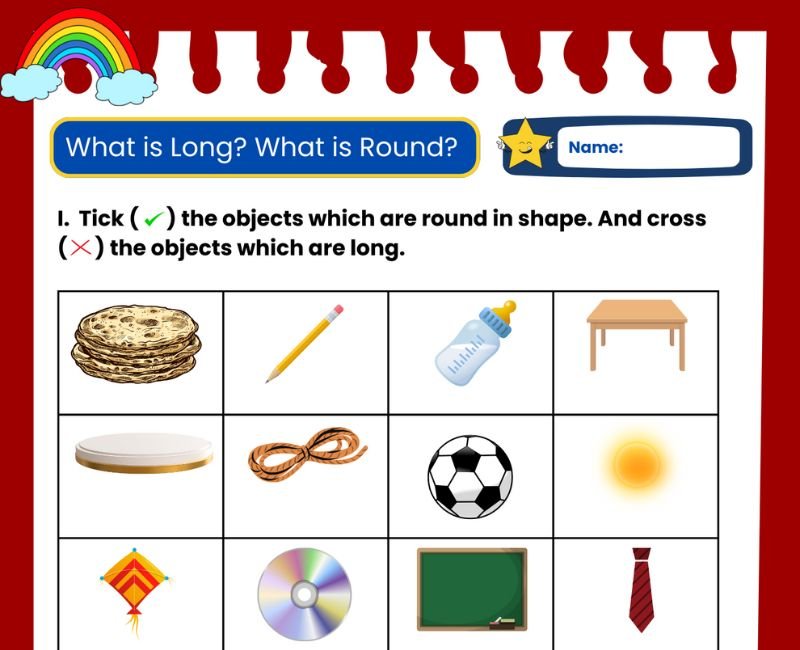
What Is Long? What Is Round? Class 1 Worksheet
Help children explore everyday shapes with this What Is Long What Is Round Class 1 worksheet. Use it alongside NCERT Class 1 Maths Chapter 2 - What Is Long? What Is Round? (Shapes) in the Joyful Mathematics textbook.
A ball, a pencil box and a toy block give children plenty to observe. Which objects look long? Which have curved surfaces? What happens when we gently push them? The original activities below provide extra practice with shape matching, sorting, rolling and sliding alongside the downloadable worksheet.
Look, Describe and Compare
Begin by showing familiar objects rather than asking children to memorise definitions. Invite them to describe an object's shape, point to its surfaces and explain what they notice.
A pencil can be described as long, while a ball looks round. However, these descriptions are not always opposite categories. A cylindrical object can be long and also have round ends. Accept sensible observations and ask children to explain which part they are describing.
Use questions such as "What does this look like?" and "Can you find another object with a similar shape?" These discussions connect mathematical vocabulary with things children can handle and examine.
Sort Objects by Similar Shape
Collect a ball, a rectangular box, a toy block and an empty cylindrical container. Ask the child to find another object similar in shape to each one. Explain that objects can have similar shapes even when their colours, sizes and uses differ.
Ball and orange: both are roughly spherical.
Rectangular pencil box and rectangular carton: both have a similar box-like shape.
Cylindrical container and cylindrical chalk: both have round ends and a curved side.
Focus on the actual objects being used. A pencil box or container may have a different shape from the examples, so inspect it before deciding on a match.
Rolling and Sliding: Notice the Movement
An object rolls when it turns over as it moves. An object slides when it moves along a surface without turning over. Watch the motion rather than deciding from the object's name alone.
A ball rolls when gently pushed. A rectangular block can slide on a flat face. A cylindrical container can roll on its curved side and slide when resting on a flat end. Its movement depends on how it is placed and pushed.
For beginners, use a stable surface or a gently sloping board. Ask children to predict the movement, test it and describe what happened. Repeat with the object in a different position.
Try a Roll-and-Slide Investigation
- Choose a ball, a rectangular block and an empty cylindrical container.
- Predict whether each will roll or slide.
- Gently push each object and observe its movement.
- Place the cylindrical container on its side, then on its flat end.
- Discuss which object can show both kinds of movement.
Use lightweight objects that are easy to handle. If an object does not move because of friction, try a smoother surface rather than assuming its shape prevents movement.
The aim is to observe and explain. Let children revise an earlier prediction after seeing the result.
Original Chapter 2 Practice Questions
Read each question aloud if needed. These additional questions use the situations described here.
- Which is roughly spherical: a ball or a rectangular book?
- A ball turns over while moving. Is it rolling or sliding?
- A block moves on a flat face without turning. Is it rolling or sliding?
- Which part of a cylindrical container helps it roll: the curved side or the flat end?
- Can a cylindrical container roll and slide when placed differently?
- Can two objects have similar shapes but different colours?
Show Practice Answers
1. A ball
2. Rolling
3. Sliding
4. The curved side
5. Yes
6. Yes
Make Shapes with Clay
Give the child a little modelling clay and ask them to make a ball-like object, a long cylinder and a block. Compare the surfaces and gently test how the clay objects move.
A clay model may not be perfectly shaped, so discuss why it moves unevenly. This is an opportunity to connect careful observation with the object's actual form.
Follow with a classroom shape hunt. Children can point to objects that resemble their models and describe what is similar. Encourage discussion of shape separately from colour and size.
How to Use the NCERT Class 1 Chapter 2 Worksheet
Use the worksheet download option on this page alongside the Joyful Mathematics textbook. Discuss the objects or pictures first, then let the child attempt the questions independently.
Ask for a reason: "It rolls because I saw it turning" is more informative than a guessed answer. Children can demonstrate understanding through speaking, pointing, matching or testing real objects before writing.
Check the pictured shape and its position when reviewing rolling-and-sliding answers. Avoid teaching that every long object slides or every round-looking object only rolls. The examples on this page are supplementary activities; answers to worksheet pictures depend on the actual objects shown.
More NCERT Joyful Mathematics Worksheets
Continue with these related Class 1 Maths chapters.
Chapter 1: Finding the Furry CatPractise inside, outside, on, under and other position words. Chapter 3: Mango Treat
Develop counting skills with numbers from 1 to 9. Chapter 9: Utsav
Recognise and extend patterns. Chapter 13: So Many Toys
Sort, count and compare groups of objects.
Related General Grade 1 Maths Worksheets
Spatial Understanding Worksheet for Class 1Explore positions and spatial relationships through additional practice. Browse All Grade 1 Maths Worksheets
Find general topic practice and NCERT chapter worksheets.
What Is Long? What Is Round? Class 1 FAQs
Which chapter is What Is Long? What Is Round?
It is Chapter 2 of the NCERT Joyful Mathematics Class 1 textbook. It explores shapes, similar objects, rolling and sliding.
What is the difference between rolling and sliding?
Rolling involves an object turning as it moves. Sliding involves movement along a surface without turning over.
Which objects can both roll and slide?
A cylindrical object can roll on its curved side and slide on a flat end. Its movement depends on its position, the surface and how it is pushed.
Can an object be both long and round?
Yes. A long cylindrical container has a long body and round ends. Children should explain which feature they are describing.
How can I teach shapes without formal shape names?
Begin with familiar objects and descriptions such as ball-like or box-like. Ask children to find similar objects and describe their surfaces.
Does a round outline mean an object is a ball?
No. A plate can have a round outline but is not spherical. Examine the whole object rather than only its outline or one face.
Can children practise this chapter without reading independently?
Yes. An adult can read the directions while the child responds by pointing, matching, speaking or testing objects.
Are answers available for the practice questions on this page?
Yes. Open "Show Practice Answers" below the original questions. These answers apply to the situations described on this page.
 Download