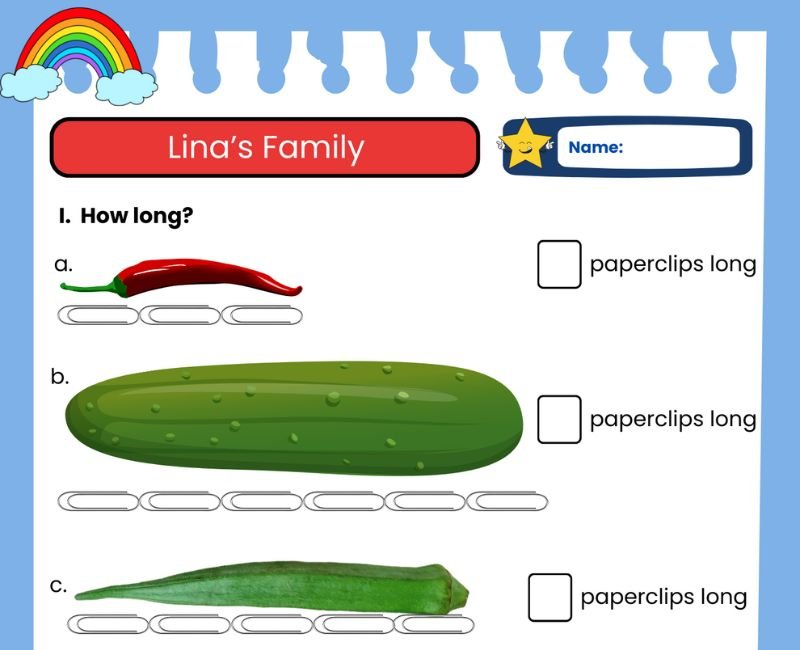
Lina's Family Class 1 Worksheet
Help children explore everyday measurement with this Lina's Family Class 1 worksheet. Use it alongside NCERT Class 1 Maths Chapter 7 - Lina's Family (Measurement) in the Joyful Mathematics textbook.
Children learn through comparing, estimating and checking. They can arrange objects by length, compare heights, explore heavier and lighter objects and find which containers hold more water. The original activities and practice questions with answers below support discussion at home or school alongside the worksheet available on this page.
Compare Heights and Lengths Fairly
Introduce words such as taller, shorter, longer and longest through objects children can compare directly. Place two pencils side by side with their ends aligned. The pencil that reaches farther is longer.
When comparing height, people should stand on the same level surface. Standing on a stool changes how high someone reaches but does not change their actual height. For classroom discussion, compare toy figures or blocks placed on the same table.
Arrange three strips of paper from shortest to longest. Ask the child to explain the order by pointing to the ends. Then change the arrangement and check whether the lengths themselves have changed.
Explore Thick, Thin, Near and Far
Length is only one feature of an object. Two crayons may have the same length but different thicknesses. Compare a thick marker with a thin pencil and ask which feature is being described.
Use familiar places to talk about distance. Place a toy house, shop and school on a table. Ask which place is nearer to the house and which is farther away. Always make the reference point clear: an object may be near the house but far from the school.
Encourage complete descriptions such as "The shop is nearer to the house than the school." This helps children connect comparison words with the situation they can see.
Measure with Handspans and Finger Widths
A handspan is the distance from the tip of the thumb to the tip of the little finger when the hand is stretched out. Children can use repeated handspans to explore the length of a table or a book. Finger widths can help with smaller objects.
Start at one end, keep the same measuring unit and place each unit next to the previous one. Avoid gaps and overlaps. Count how many units cover the length.
Different people have different-sized hands, so their handspan counts for the same table may differ. For a fair comparison of two objects, use the same person's handspan or identical paper strips. Do not treat every child's practical measurement as having one fixed answer.
Compare Heavier and Lighter Objects
Explore weight with familiar objects. Compare an empty pencil box with the same box after adding crayons. The filled box is heavier because objects have been added.
Size alone does not tell us which object is heavier. A large empty cardboard box can be lighter than a smaller box containing books. Let children predict, compare manageable objects and explain whether their prediction was correct.
If a suitable balance is available, use it to compare objects. On a simple balance, the side containing the heavier load goes down. When both sides balance, the loads have equal weight.
Capacity: Which Container Holds More?
Capacity tells us how much a container can hold. Compare two containers by filling them with the same small cup. Count how many full cups are needed to fill each one, using the same cup throughout.
For example, if one container holds three cups and another holds five of the same cup, the second has greater capacity. This conclusion depends on equal cupfuls and the same filling method.
A taller container does not always hold more than a shorter one. A short, wide container may hold more than a tall, narrow container. Predict first, then test with water over a tray and with adult help.
Original Lina's Family Practice with Answers
Use these additional questions for oral discussion or notebook practice. The information needed for each answer is included in the question.
- Two ribbons start at the same point. The red ribbon extends farther than the green ribbon. Which is longer?
- Asha and Ravi stand on the same level floor. Ravi's head is higher. Who is taller?
- Which word compares thickness: thicker or longer?
- A table measures six identical paper strips. A bench measures four of the same strips. Which is longer?
- Two children have different-sized handspans. Must their measurements of the same desk match?
- Which is heavier: an empty box or the same box containing books?
- Container A holds two cups of water. Container B holds four of the same cup. Which holds more?
- Can we decide which container holds more just by comparing its height?
- Should there be gaps between measuring strips?
- A toy shop is two equal steps from a toy house. A toy school is five equal steps away. Which is nearer to the house?
Show Practice Answers
1. The red ribbon
2. Ravi
3. Thicker
4. The table
5. No; their handspans may differ in size
6. The box containing books
7. Container B
8. No; compare or measure their capacities
9. No
10. The toy shop
How to Use the Class 1 Chapter 7 Worksheet
Use the worksheet download option on this page alongside the NCERT textbook. Discuss each picture, read instructions aloud when needed and ask children to explain the feature they are comparing.
Combine written practice with real measurements. Ask the child to predict which book is longer or which container holds more, then check the prediction. Keep a simple record using phrases such as "five paper strips long" rather than recording only a number.
Actual handspan counts, family heights and container measurements vary. Accept answers supported by careful observation and a consistent method. The answers above apply to the original examples on this page; practical tasks and picture-based worksheet answers depend on the objects or pictures provided.
More NCERT Class 1 Maths Worksheets
Choose another chapter-based Joyful Mathematics resource.
Chapter 2: What Is Long? What Is Round?Revisit shapes and the properties of familiar objects. Chapter 6: Vegetable Farm
Practise addition and subtraction up to 20. Chapter 8: Fun with Numbers
Continue exploring numbers from 21 to 99. Chapter 9: Utsav
Explore patterns in familiar surroundings.
Browse General and NCERT Grade 1 Maths Practice
Explore All Class 1 Maths WorksheetsFind general topic practice and NCERT chapter worksheets for further learning.
Lina's Family Class 1 FAQs
Which chapter is Lina's Family in Class 1 Maths?
Lina's Family is Chapter 7 of NCERT Joyful Mathematics. The chapter introduces measurement through everyday comparisons and activities.
What measurement topics can children practise?
Children can compare length, height, thickness, distance, weight and capacity, and explore informal ways of measuring length.
What is a handspan?
A handspan is the distance between the tips of the thumb and little finger when the hand is stretched out.
Why do handspan measurements differ between children?
Their hands may differ in size. A larger handspan usually covers the same length in fewer repetitions than a smaller handspan.
How can children compare lengths accurately?
Align one end of both objects. When using measuring units, use equal-sized units without gaps or overlaps.
Is the biggest object always the heaviest?
No. Weight depends on more than size. A large empty box may be lighter than a smaller box containing books.
Is the tallest container always the one with greatest capacity?
No. Its width and shape also matter. Use the same cup to compare how much each container holds.
Do all practical measurement questions have one fixed answer?
No. Answers depend on the object and measuring unit used. Record the unit and check that the method is consistent.
Are answers provided for the practice questions?
Yes. Open Show Practice Answers to check the ten original examples on this page.
 Download