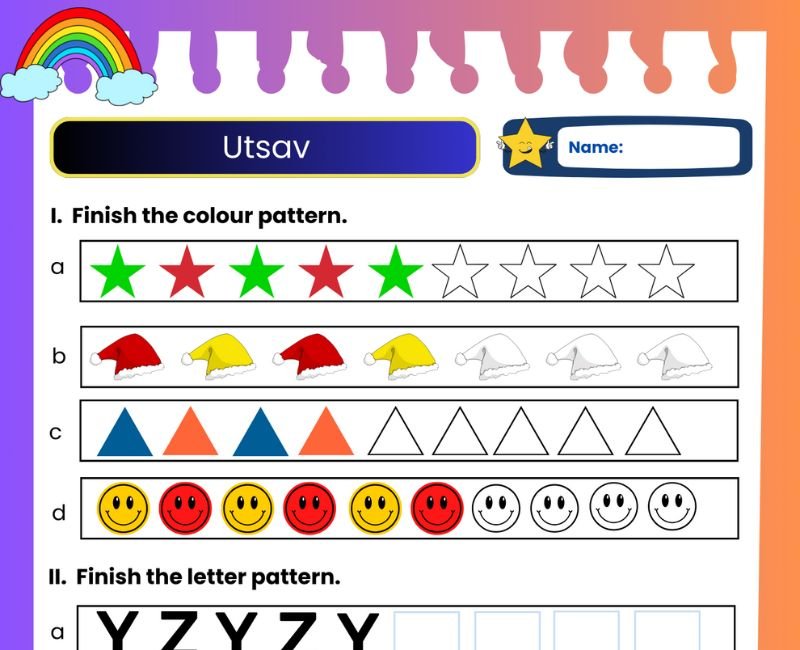
Utsav Class 1 Worksheet
Discover patterns through colours, shapes, movements and numbers with this Utsav Class 1 worksheet. Use it alongside NCERT Class 1 Maths Chapter 9 - Utsav (Patterns) in the Joyful Mathematics textbook.
Children learn to notice a rule, explain what repeats and decide what comes next. Decorations, clothing borders and familiar classroom objects provide opportunities to explore patterns. The original activities and practice questions with answers below offer additional examples for home learning and classroom discussion alongside the worksheet available on this page.
Find the Part That Repeats
Begin with a simple sequence: red, yellow, red, yellow, red, yellow. The smallest repeating group is red, yellow. Ask the child to say this group aloud and use it to continue the sequence.
A repeating unit can contain more than two items. In circle, circle, square, circle, circle, square, the unit is circle, circle, square. Notice both the items and their order.
Place a small gap between repeated groups while teaching the idea. Once children recognise the unit, remove the gaps and ask them to find it independently. Naming the repeating unit is more useful than guessing the next item.
Explore Colour and Shape Patterns
Use coloured paper pieces or blocks to build patterns. Start with two alternating colours, then try three colours or repeated pairs. Invite children to point, name the items and predict the next two positions.
Purple, green, green | Purple, green, green | Purple, ______, ______
The repeating unit is purple, green, green, so the two spaces need green and green. When using shapes, change only one feature at first. Later, combine shape and colour so children can describe exactly which feature follows the rule.
Make Patterns with Sounds and Actions
Patterns do not have to be drawn. Clap, tap, clap, tap forms an action pattern. Ask children to continue it and then describe the repeating pair.
Try clap, clap, tap, clap, clap, tap. Children should repeat the complete group of three actions. Work slowly so they can hear the order clearly.
Take turns being the pattern leader. One child creates a short sequence and another repeats it. Ask the leader to explain the rule before changing it. This helps children connect spoken descriptions with the actions they perform.
Complete Missing Parts and Check the Whole Sequence
A missing item may appear in the middle rather than at the end. For example, leaf, flower, leaf, blank, leaf, flower needs flower in the empty position.
Look at the items on both sides of the gap. Find the repeating unit and check whether the completed sequence follows it throughout. Looking only at the item immediately before the gap can lead to an incorrect answer.
Use a deliberate mistake as a discussion activity. In red, green, red, green, green, green, the fifth item breaks an alternating red-green rule. Ask children to correct the item and read the whole sequence again.
Explore Simple Number Patterns
Number patterns follow a numerical rule. In 10, 20, 30, 40, the rule is to add ten each time. In 2, 4, 6, 8, the rule is to add two.
Use a number strip or objects to show what changes. For counting by twos, arrange objects in pairs and count the totals. For counting by tens, use complete groups of ten.
Explain the intended rule before asking for a missing number. A short number sequence can sometimes fit more than one rule. For early practice, use a clear instruction such as "Count forward in tens" so children know what to apply.
Original Utsav Practice Questions with Answers
Use the stated repeating unit or number rule to complete these additional examples.
- Repeat red, yellow: red, yellow, red, yellow, ______.
- Repeat circle, square: circle, square, circle, ______.
- Repeat clap, clap, tap: clap, clap, tap, clap, clap, ______.
- Repeat leaf, flower: leaf, flower, leaf, ______, leaf, flower.
- Repeat purple, green, green: purple, green, green, purple, ______, ______.
- Count forward in tens: 20, 30, 40, ______, ______.
- Count forward in twos: 2, 4, 6, ______, ______.
- Count backward in ones: 18, 17, 16, ______.
- Find the repeating unit: star, star, moon, star, star, moon.
- Create a pattern that repeats big, small. Write six items.
Show Practice Answers
1. Red
2. Square
3. Tap
4. Flower
5. Green, green
6. 50, 60
7. 8, 10
8. 15
9. Star, star, moon
10. Big, small, big, small, big, small
How to Use the NCERT Class 1 Chapter 9 Worksheet
Use the worksheet download option on this page alongside the Joyful Mathematics textbook. Read instructions aloud when needed and ask children to describe a pattern before completing it.
Begin with objects, then move to drawings and written sequences. Ask, "Which part repeats? How do you know what comes next?" If a child makes a mistake, rebuild the sequence with blocks and check each complete group.
Finish by letting the child create a pattern for someone else to continue. For open-ended tasks, accept different designs when they follow a clear, consistent rule. The answers above apply to the original examples on this page; picture-based worksheet answers depend on the actual patterns shown.
More NCERT Class 1 Maths Worksheets
Choose a related chapter-based Joyful Mathematics resource.
Chapter 2: What Is Long? What Is Round?Revisit shapes and the properties of familiar objects. Chapter 7: Lina's Family
Explore measurement and everyday comparisons. Chapter 8: Fun with Numbers
Practise numbers from 21 to 99 and tens and ones. Chapter 13: So Many Toys
Count and compare collections in data-handling activities.
Browse General and NCERT Grade 1 Maths Practice
Explore All Class 1 Maths WorksheetsFind general topic practice and NCERT chapter worksheets for further learning.
Utsav Class 1 FAQs
Which chapter is Utsav in Class 1 Maths?
Utsav is Chapter 9 of NCERT Joyful Mathematics. The chapter focuses on patterns.
What is a repeating pattern?
It is a sequence in which a group of items occurs again in the same order, such as red, yellow, red, yellow.
What is a repeating unit?
It is the smallest group that repeats to create the pattern. In circle, circle, square repeated several times, the unit is circle, circle, square.
How can I teach patterns without pictures?
Use actions or sounds, such as clap, tap, clap, tap. Ask the child to continue and explain the repeating unit.
How do children find a missing item?
Identify the rule, check the items before and after the gap and test the completed sequence against that rule.
What is the difference between repeating and growing patterns?
A repeating pattern repeats a fixed group. A growing pattern changes according to a rule, such as adding one block at each stage.
Can children create their own patterns?
Yes. Encourage them to choose objects or colours, state a rule and repeat it consistently.
Are answers provided for the practice questions?
Yes. Expand Show Practice Answers to check the ten original examples on this page.
 Download