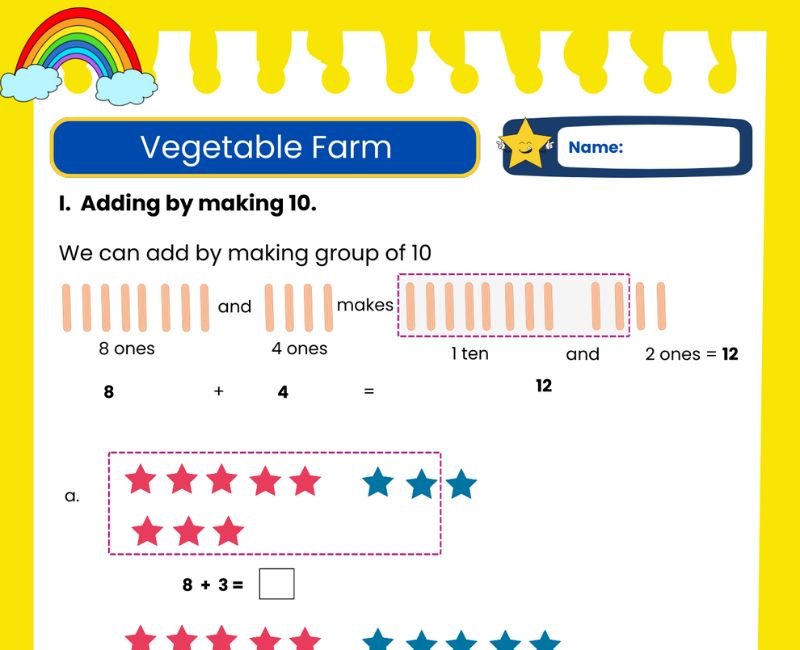
Vegetable Farm Class 1 Worksheet
Bring early arithmetic to life with this Vegetable Farm Class 1 worksheet. Use it alongside NCERT Class 1 Maths Chapter 6 - Vegetable Farm (Addition and Subtraction up to 20) in the Joyful Mathematics textbook.
Familiar vegetable-counting situations help children connect numbers with quantities. They can combine two collections, find how many remain after some are removed and explain their calculations using counters, drawings or a number path. The original practice questions with answers below offer additional examples alongside the worksheet available on this page.
Addition up to 20: Join Two Collections
Show twelve counters as vegetables in one basket and four in another. Bring the groups together and ask how many there are altogether. Children can count every counter or start at twelve and count on four: thirteen, fourteen, fifteen, sixteen.
12 tomatoes + 4 tomatoes = 16 tomatoes
12 + 4 = 16
Ask children to point to the quantities represented by each number. The written calculation should describe the objects they have counted. Encourage them to explain why joining the baskets increases the total.
Subtraction up to 20: Find What Remains
Begin with fifteen counters. Remove four to represent vegetables sold at a stall. Count the remaining eleven counters and write 15 - 4 = 11.
For a drawing, cross out four of the fifteen objects and count those that are not crossed out. Discuss the starting quantity, the number removed and the number left. This helps children understand the action instead of choosing an answer by guessing.
Try another example: a basket contains eighteen carrots and six are used for cooking. Twelve carrots remain, so 18 - 6 = 12.
Use a Group of Ten to Organise Counting
Arrange a collection of fourteen counters as ten together and four extra. This makes the quantity easier to see and connects with earlier learning in Making 10.
To represent 14 + 3, keep the group of ten and add three to the four extras. There are now ten and seven, making seventeen. To represent 16 - 4, remove four from the six extras. Ten and two remain, making twelve.
Let children use whichever representation they understand. A clear explanation with objects is more useful than rushing into a written method they cannot yet describe.
Move Forward and Back on a Number Path
Draw a number path from 0 to 20. To show 11 + 5, start at eleven and move forward five spaces. You land on sixteen. To show 17 - 3, start at seventeen and move back three spaces. You land on fourteen.
Count each move carefully. The starting position is not the first move. Ask the child to move a counter one space at a time while keeping track of how many moves have been made.
Number paths give children another way to check a calculation. They can compare the result with their counters or drawings and discuss any difference.
Understand Vegetable Story Problems
Read a short story aloud: "A farmer picks nine radishes in the morning and five more in the evening. How many radishes did the farmer pick?" Children can show two groups, combine them and write 9 + 5 = 14.
Next, try: "A shopkeeper has sixteen potatoes and sells seven. How many potatoes remain?" Begin with sixteen and remove seven to find nine.
Ask what happened in the story before choosing addition or subtraction. Encourage children to draw a picture or act out the situation. Include the object name in the final answer, such as fourteen radishes or nine potatoes.
Original Vegetable Farm Practice with Answers
Use these additional questions orally or in a notebook. Counters and drawings are welcome.
- 11 + 3 = ______
- 8 + 7 = ______
- 13 + 5 = ______
- 16 - 4 = ______
- 19 - 6 = ______
- 14 - 8 = ______
- Complete: 12 + ______ = 17.
- Complete: 18 - ______ = 10.
- A basket has nine tomatoes. Six more are added. How many tomatoes are there now?
- A farmer has seventeen carrots and sells five. How many carrots remain?
- Start at 13 and move forward four spaces. Where do you land?
- Start at 15 and move back three spaces. Where do you land?
Show Practice Answers
1. 14
2. 15
3. 18
4. 12
5. 13
6. 6
7. 5
8. 8
9. 15 tomatoes
10. 12 carrots
11. 17
12. 12
How to Use the NCERT Class 1 Chapter 6 Worksheet
Use the worksheet download option on this page alongside the Joyful Mathematics textbook. Discuss the pictures and read instructions aloud when needed. Allow children to choose objects, drawings or a number path to work out an answer.
Practise a few questions at a time. If a child makes a mistake, ask them to rebuild the collection and show what changes. Check whether they counted an object twice, missed a move or misunderstood the story.
At home, blocks can stand for vegetables. In class, children can take turns explaining a pretend market transaction. The answers above apply to the original on-page examples; answers to picture-based worksheet tasks depend on the actual pictures provided.
More NCERT Class 1 Maths Worksheets
Choose a related NCERT Joyful Mathematics chapter for revision or further learning.
Chapter 4: Making 10Revisit groups of ten and numbers from 10 to 20. Chapter 5: How Many?
Build confidence with single digit addition and subtraction. Chapter 8: Fun with Numbers
Continue exploring numbers from 21 to 99. Chapter 13: So Many Toys
Count and compare collections in data-handling activities.
Related General Grade 1 Maths Practice
Comparing Numbers Worksheets for Class 1Extra topic-based practice for comparing quantities and numbers. Browse All Class 1 Maths Worksheets
Explore general topic resources and NCERT chapter worksheets.
Vegetable Farm Class 1 FAQs
Which chapter is Vegetable Farm in Class 1 Maths?
Vegetable Farm is Chapter 6 of NCERT Joyful Mathematics. Its focus is addition and subtraction up to 20.
How is Vegetable Farm different from How Many?
How Many? introduces addition and subtraction of single digit numbers. Vegetable Farm extends practice to quantities up to twenty.
How can I teach addition up to twenty?
Build two collections, join them and count the total. Then practise counting on from a known quantity using counters or a number path.
How can children solve subtraction with pictures?
Draw the starting collection, cross out the objects being removed and count those remaining.
Can a group of ten help with calculations?
Yes. Grouping ten objects together makes teen numbers easier to represent. Fourteen, for example, is ten and four more.
Why does my child make mistakes when counting on?
Check whether the starting number is being counted as the first extra count. For 12 + 3, the three extra counts are thirteen, fourteen and fifteen.
How do I help with a vegetable word problem?
Read it aloud, ask what changed and let the child act it out with counters. Write a number sentence after the situation is understood.
Are answers available for the practice questions?
Yes. Open Show Practice Answers to check the twelve original examples on this page.
 Download