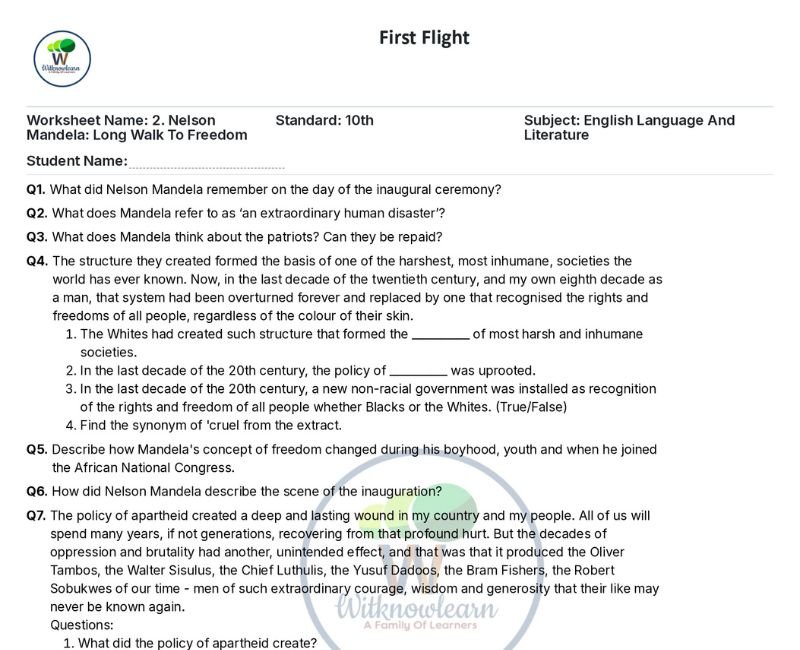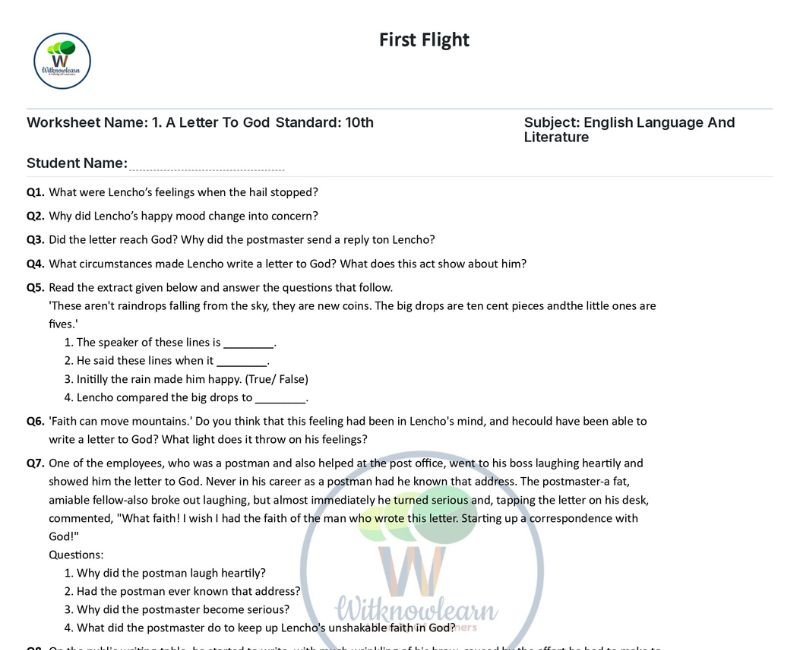
A Letter to God Class 10 Worksheet with Answers
Knowing what happens in a story is the first step. Explaining a character’s motives, supporting an inference and recognising irony require closer reading. Use this A Letter to God Class 10 worksheet with answers to turn your understanding of the chapter into clear, relevant written responses.
Practise independently before checking the answers. Focus on what each question asks, select useful details from the text and explain how those details support your point.
Move from Remembering the Story to Explaining It
“A Letter to God” by Gregorio López y Fuentes invites readers to examine faith, human kindness and mistaken judgement. For worksheet practice, use your knowledge of the events to explain why characters act as they do and how the ending changes the reader’s understanding.
Begin by identifying the task word. A question asking you to identify needs a precise detail. A question asking you to explain needs a reason. A question asking you to justify requires evidence supporting a judgement.
This distinction helps you avoid writing a full chapter summary when the question requires only one focused explanation.
Build Strong Reading-Comprehension Skills
When working with an extract, read it once for the situation and again for the question. Notice who is speaking, what has just happened and which words reveal the speaker’s attitude.
Separate information stated directly from conclusions you must infer. A factual answer should match the passage. An inference should be reasonable and supported by a detail, rather than based on an invented event.
A Useful Routine for Extract Questions
- Identify the speaker or narrative situation.
- Underline the exact demand of the question.
- Locate a supporting word, action or detail.
- Write the answer in your own words.
- Check that your explanation stays within the evidence.
For vocabulary questions, test the meaning in the sentence. A word’s familiar dictionary meaning may not be the meaning intended in that context.
Practise Character-Based Answers with Evidence
Character questions become stronger when you connect a quality with an action. Instead of listing several adjectives, choose a relevant trait and explain what demonstrates it.
Lencho can be discussed through his relationship with farming, his response to difficulty and his certainty about divine help. The postmaster can be examined through the difference between his initial reaction and his subsequent decision to assist.
A balanced answer can recognise more than one aspect of a character. Strong belief may provide emotional support while also influencing how someone interprets evidence. Avoid reducing a complex character to a single unsupported label.
Practice Prompt: Explain a Change in Attitude
Question: How does the postmaster’s response develop, and what does this reveal about him?
Answer approach: Identify his initial amusement, explain his later respect for Lencho’s faith and connect his practical effort to compassion. The important step is showing how the change in response reveals character.
Understand Irony Before Writing About It
To explain irony, establish the contrast between what a character believes and what the reader knows. Naming the technique without explaining that contrast leaves the answer incomplete.
Try this practice question: How does the ending challenge Lencho’s judgement of other people? Build your response around the difference between the helpers’ intentions and his interpretation of their actions.
You can also examine how humour and disappointment coexist in the ending. A thoughtful response explains the effect on the reader instead of simply declaring the ending funny or sad.
Question Types to Include in Your Practice
Use a mixture of tasks to check different reading and writing skills. The following practice areas help you move beyond memorised answers.
| Practice Area | Skill to Develop | Answer-Writing Focus |
|---|---|---|
| Factual comprehension | Accurate recall and selection | Give the requested detail without unrelated events. |
| Extract-based inference | Reading beyond explicit statements | Support your conclusion with a clue from the passage. |
| Character analysis | Connecting behaviour with qualities | Explain a relevant action and what it reveals. |
| Theme and irony | Interpreting the writer’s choices | Show the contrast or relationship clearly. |
| Vocabulary and imagery | Understanding language in context | Explain meaning and its effect in the situation. |
| Extended response | Organising a supported argument | Develop connected points instead of retelling the plot. |
Write Short Answers That Stay Focused
Start with a direct response to the question. Follow it with a relevant detail and a brief explanation. This creates a clear sequence: point, evidence and explanation.
For a question about motivation, explain the reason behind the action. For a comparison, discuss both sides using the same basis. Follow the word limit stated in the task rather than assuming every short answer needs the same length.
Replace Retelling with Explanation
After writing each sentence, ask: “Does this answer the question, provide evidence or explain my point?” Remove sentences that do none of these. Clear answers usually improve through better selection, not through adding more events.
Develop Longer Answers Around a Clear Viewpoint
For an extended response, decide your main judgement before you begin. Organise two or three supporting ideas and connect each to a relevant detail.
A prompt about faith and human kindness should discuss their relationship. A prompt evaluating Lencho’s judgement should consider his reasons and the limits of his interpretation. Conclude by returning to the question rather than adding a general moral unrelated to your argument.
Alternative interpretations can be valid when supported by the text. The goal is a convincing explanation, not an exact copy of a model answer.
Use the Answers as Feedback
Complete the worksheet before consulting the answers. Then compare the meaning, evidence and reasoning of your response with the suggested answer.
- Check accuracy: Have you confused a person, event or motivation?
- Check relevance: Have you addressed every part of the question?
- Check support: Does your explanation include a useful textual detail?
- Check expression: Are your sentences clear and grammatically complete?
Rewrite one weak response after checking it. This turns answer checking into active improvement and helps you recognise mistakes before repeating them.
Revise the Chapter Before a Second Attempt
If you need help with the events or textbook questions, visit A Letter to God Class 10 questions and answers. Return to the worksheet afterwards and answer independently to check what you have understood.
Frequently Asked Questions About A Letter to God
Why does Lencho compare the raindrops with coins?
He expects the rain to support a successful harvest and therefore bring income. The comparison connects rainfall with his family’s livelihood.
Why does Lencho ask for one hundred pesos?
He needs money to sow his field again and support his family until the next crop becomes available. His request responds to the loss of both food and future income.
Why does the postmaster decide to help Lencho?
He is moved by Lencho’s extraordinary faith and wants to preserve it. His response turns sympathy into practical assistance.
Why is Lencho angry after receiving seventy pesos?
He is certain that God would send the full amount requested. He therefore interprets the shortfall as theft by the postal employees instead of recognising the limits of their collection.
What is ironic about the ending?
Lencho accuses the very people who have helped him. The reader knows their generosity, while he misunderstands their role and suspects dishonesty.
Should Lencho be described only as ungrateful?
A balanced answer explains his mistaken accusation while also considering his hardship, simplicity and unquestioning faith. Support your judgement with his actions rather than relying on one label.
What are the two conflicts in the story?
The natural conflict involves the storm’s destruction of the crop. The human conflict arises when Lencho suspects the postal employees, even though they have acted kindly towards him.
Must my answer use the exact words of the answer key?
No. Use clear wording of your own while preserving the correct meaning and supporting details. Follow any specific instruction that asks for a quotation or an exact word from an extract.
 Download