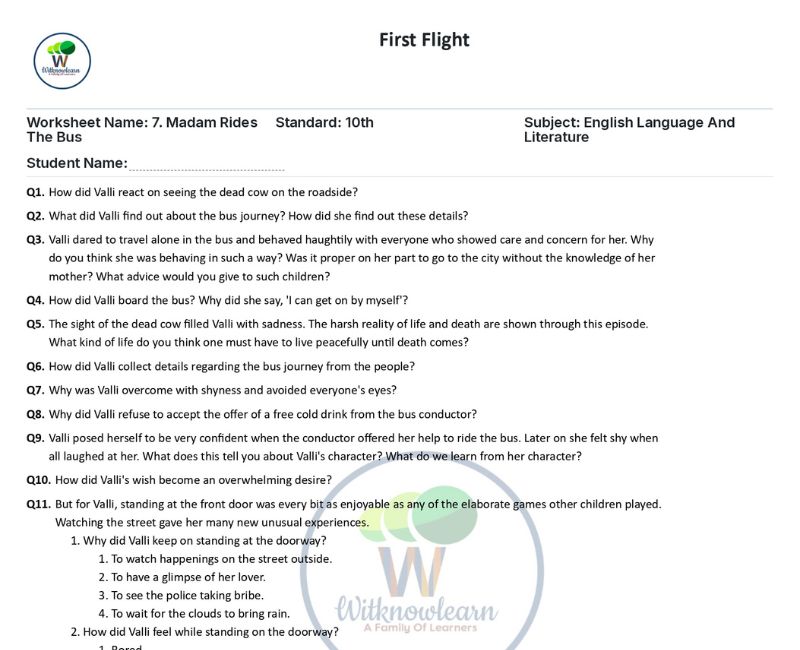
Madam Rides the Bus Class 10 Worksheet with Answers
For Valli, a bus journey is a carefully planned adventure into a world beyond her doorstep. Use the Madam Rides the Bus Class 10 worksheet with answers to practise explaining her determination, interactions with adults and changing response to what she sees.
Attempt the questions independently before checking the answers. Develop responses that connect actions with motives and support interpretations with relevant details from the story.
Practise More Than Plot Recall
“Madam Rides the Bus” by Vallikkannan presents a child’s first independent journey through curiosity, humour and an unexpected encounter with loss. These shifts offer useful opportunities for close reading and thoughtful answer writing.
The worksheet follows a mixed English practice format, combining short and long-answer work with extract-based questions, objective responses and vocabulary activities. Use the question section for independent practice and the answers for checking understanding afterwards.
Read the task word before writing. An identification question needs a precise detail; an explanation needs a reason; an evaluation requires a supported judgement.
Explain How Valli Turns a Wish into a Plan
Questions about preparation should connect Valli’s observations, information gathering, saving and timing. Explain how these actions help her turn a strong desire into a practical plan.
When discussing her determination, choose an example of something she gives up or carefully arranges. State what the action reveals rather than simply repeating that she wants to ride the bus.
Distinguish planning from impulsiveness. Her decision is secret, but her preparations show deliberate attention to details. A balanced answer can recognise both aspects when the question invites evaluation.
Practice Prompt: Support a Character Judgement
Question: How do Valli’s preparations reveal patience and self-control?
Answer approach: Select details about gathering information and saving money. Explain how delaying smaller pleasures helps her work towards a larger goal.
Interpret Her Conversations with Adults
Valli’s exchanges with the conductor and fellow passengers reveal her wish to be treated as an independent person. Examine what she objects to, how she responds and what her language suggests about her self-image.
For questions about the conductor’s behaviour, connect his playful tone with his responses to Valli. Explain how their interaction creates humour without assuming that every remark is hostile.
A character answer should recognise the contrast between Valli’s confident speech and her limited experience. This makes her more complex than a simple label such as “mature” or “stubborn”.
Read Extracts for Situation and Tone
Locate each passage within the journey before answering. Is Valli planning the trip, boarding, enjoying the view, reaching the town or returning home? The context helps you interpret her mood and motives accurately.
For extract-based MCQs, compare all options with the passage. For True/False statements, check the whole claim, including qualifiers. For fill-in-the-blank questions, ensure your answer matches the detail and fits the sentence.
Vocabulary and synonym tasks require contextual reading. Words expressing eagerness, irritation, amusement or sadness contribute to the scene’s tone.
A Routine for Passage-Based Practice
- Identify the speaker and stage of the journey.
- Read the exact demand of the question.
- Locate a supporting action, expression or detail.
- Answer directly, explaining the evidence when required.
- Check that the response stays within the passage.
When a task asks for a word from the extract, provide the word appearing there rather than a different synonym.
Trace the Change from Delight to Sadness
The cow episode provides important material for questions about emotional development. Compare Valli’s response on the outward journey with her response on the return.
A strong answer explains why recognising the same animal matters. The contrast changes the meaning of an earlier joyful scene and affects her interest in the surroundings.
When discussing maturity, use careful wording. The encounter gives Valli a new awareness of loss, but it does not mean she instantly understands every aspect of life and death.
Show the Change through Evidence
Do not stop at “Valli becomes sad”. Explain the earlier source of amusement, the later discovery and the change in her behaviour. This sequence demonstrates development rather than merely naming a feeling.
Question Types and Answer-Writing Skills
| Question Area | Skill Developed | Answer-Writing Focus |
|---|---|---|
| Valli’s wish and preparations | Motivation and cause-and-effect | Connect specific actions with determination. |
| Conversations on the bus | Character and tone analysis | Explain how dialogue reveals her self-image. |
| Extract-based objective tasks | Close reading | Match each response with the passage’s evidence. |
| The cow episode | Understanding emotional change | Compare reactions and explain the contrast. |
| The title and ending | Interpretation | Connect language and events with the story’s meaning. |
| Vocabulary and expressions | Meaning in context | Choose a meaning that fits the sentence and tone. |
Explain the Title and the Final Conversation
Questions about the title should connect “Madam” with Valli’s insistence on being treated with respect and the conductor’s playful response. Explain how the expression captures both her confidence and the humour of the journey.
The ending offers another opportunity for inference. Consider the difference between what Valli has experienced and what the adults at home know. Explain how this gap adds meaning to her response.
Avoid inventing a later confession or a change in family circumstances. Interpret the ending through the information the story provides.
Write Clear Short and Long Responses
For a short answer, begin with the main point, include a relevant detail and explain its importance. Follow the word limit stated in the question. Avoid recounting the entire trip when the task concerns one action or reaction.
For a longer character sketch, organise the response around curiosity, determination, pride and sensitivity. Support each selected quality with evidence rather than presenting an adjective list.
For a question about the journey’s effect, show both fulfilment and change. Explain how an enjoyable experience also introduces Valli to something troubling.
Practice Prompt: Develop a Balanced Interpretation
Question: Is Valli’s journey only the fulfilment of a childhood wish?
Answer approach: Explain the pleasure of achieving her goal, then examine what the return journey adds to her experience. Use the contrast to develop a balanced answer.
Use the Answers for Active Improvement
Complete your first attempt before consulting the answers. Compare the meaning, evidence and reasoning rather than expecting identical wording.
- Check sequence: have you confused outward and return events?
- Check motivation: have you explained why Valli acts as she does?
- Check evidence: does each character judgement have support?
- Check expression: are your sentences clear and complete?
Rewrite responses where the detail is correct but the explanation is incomplete. Teachers can use the worksheet for homework, classroom comprehension or discussion followed by independent writing.
Related Revision and Practice
Review the textbook responses through Madam Rides the Bus Class 10 questions and answers, then return to the worksheet for independent practice.
For another account of curiosity and learning through a journey, try the Tea from Assam Class 10 worksheet with answers.
Frequently Asked Questions About Madam Rides the Bus
Who wrote Madam Rides the Bus?
Vallikkannan wrote “Madam Rides the Bus”. The story follows an eight-year-old girl called Valliammai, or Valli.
How did Valli learn the details needed for her journey?
She listened carefully to conversations about the bus and asked discreet questions. This helped her learn about the route, fare and timing.
How did Valli save money for the bus ride?
She resisted small purchases and other pleasures, including a ride on the merry-go-round. Her saving shows patience and commitment to her goal.
How much did Valli need for the return journey?
The fare was thirty paise each way, so she saved sixty paise for the trip to town and back. These are details from the story, not present-day bus fares.
Why does the conductor call Valli “Madam”?
He responds playfully to her confident manner and insistence on being treated as an independent passenger. The address contributes to the story’s humour.
Why did Valli remain on the bus at the town?
Her goal was to experience the bus ride, and she intended to return on the same bus. She had planned the journey rather than an exploration of the town.
Why did the cow’s death affect Valli so strongly?
She recognised the animal that had amused her earlier. The contrast between its lively movement and its death changed her mood and introduced an unsettling awareness of loss.
What should a character sketch of Valli include?
Select qualities such as curiosity, determination, independence and sensitivity. Support them with her preparations, conversations and reactions rather than listing traits without evidence.
 Download