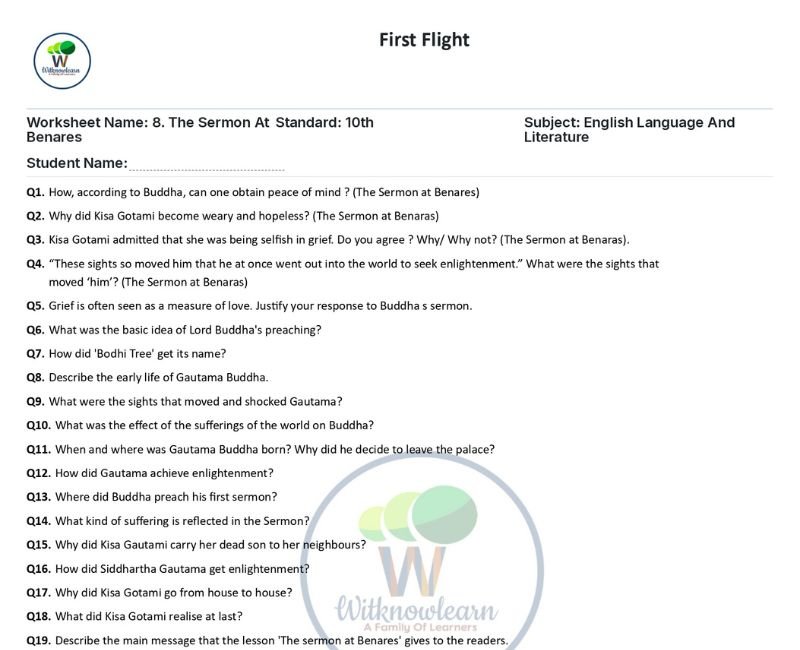
The Sermon at Benares Class 10 Worksheet with Answers
Why does the Buddha give Kisa Gotami a task instead of simply explaining that death is universal? Use The Sermon at Benares Class 10 worksheet with answers to practise interpreting her experience, the teaching method and the chapter’s reflections on suffering.
Attempt the questions independently before consulting the answers. Support your responses with relevant details and explain how the events connect with the lesson’s central ideas.
Practise Comprehension and Thoughtful Interpretation
“The Sermon at Benares” introduces the Buddha’s search for understanding and presents Kisa Gotami’s movement from desperate hope towards recognition of a shared human experience. The worksheet helps students explain these developments through clear, focused answers.
Its mixed English practice format brings together short and long-answer work, extract-based tasks, objective responses and vocabulary activities. Each type of question tests a different aspect of reading, from locating a detail to interpreting the significance of an action.
Read the instruction carefully. A factual question needs a precise response; a question about meaning or motivation requires evidence and an explanation.
Connect the Buddha’s Early Experiences with His Search
Questions about the opening account should distinguish the Buddha’s protected early life from the experiences that lead him to question suffering. Explain why the encounters matter rather than merely listing them.
For cause-and-effect questions, connect an observation with the decision it influences. Keep the answer focused on the account presented in the chapter instead of adding unrelated biographical information.
When asked about enlightenment or the first sermon, select the requested detail and explain its relevance if the question calls for interpretation.
Explain Kisa Gotami’s Request with Sensitivity
Kisa Gotami’s actions arise from overwhelming grief after losing her child. Questions about her search require you to identify what she wants and why she cannot initially accept the situation.
A character-based answer should recognise her distress while tracing the change in her understanding. Avoid reducing her to a harsh label without explaining the emotional circumstances.
If a question refers to her being focused on her own suffering, explain that perspective within the narrative. The point is her later recognition that loss affects others too.
Practice Prompt: Explain a Change in Perspective
Question: How does Kisa Gotami’s search change her understanding of her own loss?
Answer approach: Compare her initial expectation with what she discovers in other households. Explain how repeated encounters broaden her perspective beyond her individual experience.
Interpret the Mustard-Seed Task
Questions about the task require both the requested item and the condition attached to it. Omitting the condition changes the meaning of the episode.
For an interpretation question, explain why the task cannot be completed and what the search helps Kisa Gotami discover. The important connection is between the practical experience and the understanding it produces.
If asked to evaluate the Buddha’s approach, consider how learning through encounters differs from receiving a direct statement. Support the judgement with the change shown in Kisa Gotami.
Build an Answer around Cause and Effect
- State the task and its condition.
- Explain what happens during the search.
- Identify the realisation that follows.
- Connect that realisation with the chapter’s teaching.
This structure helps you explain the episode without retelling every event.
Read Extracts for Context and Meaning
Identify whether an extract describes the Buddha’s life, Kisa Gotami’s search, her reflection or the sermon itself. The context helps you interpret statements and comparisons accurately.
For extract-based MCQs, compare all options with the passage. For True/False tasks, check the complete statement. For fill-in-the-blank questions, ensure the answer fits the information and sentence structure.
Vocabulary questions require contextual reading. Words associated with grief, mortality or peace should be understood as they function in the passage rather than selected through a familiar meaning alone.
Explain Images and Comparisons
The chapter uses comparisons to communicate the uncertainty and limits of human life. When asked about an image, identify what is being compared and explain the shared idea.
Kisa Gotami’s observation of lights also offers material for interpretation. Connect what she sees with her reflection on life, rather than treating the scene as an unrelated description.
For questions on the sermon’s message, link the language with the teaching. Naming a comparison or quoting a phrase is only the first step; your explanation should show why it matters.
| Question Area | Skill Developed | Answer-Writing Focus |
|---|---|---|
| The Buddha’s early experiences | Cause-and-effect reasoning | Explain how encounters influence his search. |
| Kisa Gotami’s request | Understanding motivation | Connect her actions with grief and hope. |
| The mustard-seed task | Interpretation of teaching method | Explain the condition, discovery and realisation. |
| Extract-based objective questions | Close reading | Match the response with the passage’s evidence. |
| Images and comparisons | Analysis of language | Explain how the image supports the central idea. |
| Long and value-based responses | Supported judgement | Connect a viewpoint with relevant events and teaching. |
Write Balanced Answers about Grief and Acceptance
A response about acceptance should explain the chapter’s distinction between recognising an unavoidable reality and remaining trapped in a wish to reverse it. Keep the interpretation connected with Kisa Gotami’s experience.
Do not turn the lesson into a claim that grief is a personal failure or that sadness must disappear immediately. Discuss how the narrative presents understanding as a movement towards peace.
For value-based questions, begin with the relevant idea, such as compassion or shared humanity, and support it with an example. Explain its significance without adding an unrelated moral.
Use Respectful, Precise Language
Describe Kisa Gotami’s changing perspective with care. Explain what she initially believes, what she learns and how this affects her understanding. Evidence-based language makes the answer both thoughtful and accurate.
Organise Short and Long Responses
For short answers, state the main point, add a relevant detail and explain the connection. Follow the word limit given in the question. Avoid writing the entire account when only the purpose of one action is requested.
For longer answers, plan two or three connected points. A response about the Buddha’s teaching method can examine the task, the encounters and the resulting insight. A response about Kisa Gotami can trace her development.
Check that every sentence answers the question, supplies evidence or explains its significance. Remove repetition and keep factual details separate from interpretation.
Use the Answers for Active Revision
Complete your first attempt before checking the answers. Compare the central meaning and reasoning rather than expecting identical wording.
- Check accuracy: have you included the condition attached to the task?
- Check development: have you shown the change in understanding?
- Check evidence: does your interpretation have support?
- Check expression: are your sentences clear and complete?
Rewrite an answer where a correct event lacks an explanation. Teachers can use the worksheet for homework, classroom comprehension or discussion followed by independent writing.
Related Revision and Practice
For further practice in explaining a character’s changing response to loss, use the Madam Rides the Bus Class 10 worksheet with answers.
Compare how each chapter presents an encounter that changes the character’s understanding, using evidence from both texts.
Frequently Asked Questions About The Sermon at Benares
Why did Kisa Gotami seek help from the Buddha?
She wanted medicine that could restore her dead child to life. Her grief prevented her from initially accepting that the loss could not be reversed.
What condition did the Buddha attach to the mustard seeds?
They had to come from a household in which no one had lost a child, spouse, parent or friend. That condition was essential to the lesson she would learn.
Why could Kisa Gotami not complete the task?
Although people could offer mustard seeds, every household she approached had experienced death. She could not find one meeting the condition.
What did her search teach her?
She realised that death and bereavement were shared experiences rather than a misfortune affecting only her. This changed her perspective on her own loss.
Why did the Buddha teach through a task?
The search allowed Kisa Gotami to discover the truth through encounters with others. Her own experience helped her understand what a direct explanation had not yet made her accept.
What is the significance of the lights Kisa Gotami observes?
The lights appearing and going out lead her to reflect on human lives and their passing. The observation supports her growing understanding of mortality.
What is the central teaching of the sermon?
It presents death as an unavoidable part of human life and suggests that recognising this reality helps a person move beyond consuming lamentation towards peace.
How should I answer a question about Kisa Gotami’s transformation?
Compare her initial belief with her later realisation. Use the mustard-seed search as evidence and explain how it connects personal grief with a shared human experience.
 Download