Bholi Class 10 Worksheet with Answers
How can encouragement help a child recognise her worth and make an independent choice? Explore K. A. Abbas’s story through WitKnowLearn’s Bholi Class 10 worksheet with answers.
Practise interpreting character development, explaining the teacher’s influence and supporting theme-based responses with evidence. Attempt the questions independently, then review the clarity and accuracy of your answers.
Understand Bholi’s Growth through Close Reading
The chapter asks readers to examine the difference between how a child is judged and what she becomes capable of expressing. When answering, distinguish other characters’ assumptions from the understanding the story develops.
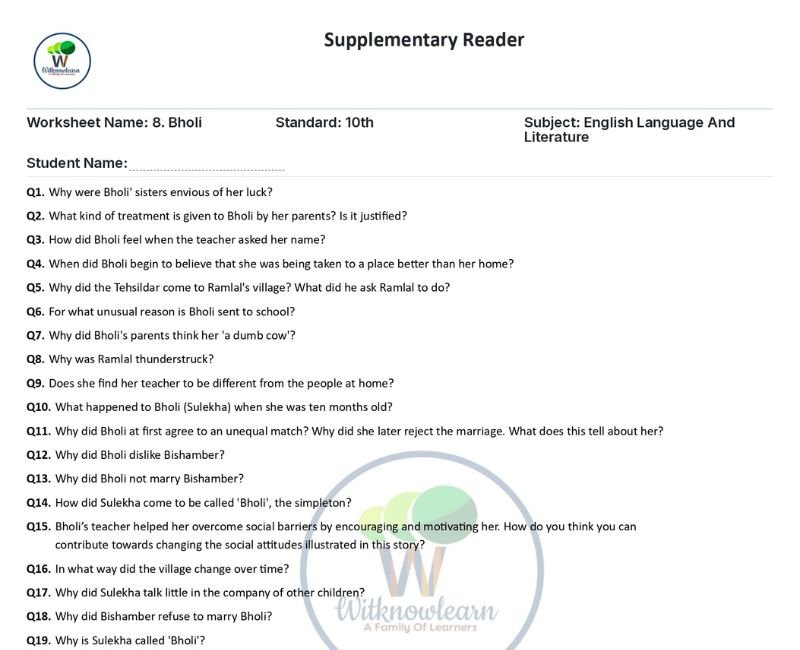
Follow the question-and-answer approach used across WitKnowLearn’s English worksheets. Work through factual tasks, extract-based activities, vocabulary questions and written responses before consulting the answers.
During your first attempt, locate supporting details in the textbook. Later, revisit selected questions without looking at the chapter. Check whether you can explain the significance of an event as well as recall it.
Bholi Questions: Areas to Practise
Examine Labels and Treatment
For questions about Bholi’s early experiences, identify how people respond to her and explain the effect of that treatment. Keep their judgement separate from your own description of her.
A careful answer uses respectful, precise language. Explain what the chapter reveals about attitudes instead of repeating a label as though it defines the character completely.
Trace the Change in Her View of School
When a question concerns her first experience of school, compare what she expects with what she encounters. Identify the detail that changes her response.
Organise your explanation around expectation, experience and effect. This helps you show why the moment matters rather than simply listing what happens.
Analyse the Teacher’s Encouragement
For questions about the teacher, select a specific action or response and explain its influence. Consider how patience and respectful attention affect Bholi’s willingness to participate.
If asked about the teacher’s role in the wider story, connect the early encouragement with later evidence of confidence. Make the relationship between the two stages clear.
Evaluate Family and Social Expectations
Questions about the family invite you to examine the reasoning behind decisions about education and marriage. Identify the assumption involved and support your explanation with the relevant detail.
When discussing a social issue, begin with the situation presented in the chapter. Develop the interpretation through the characters’ actions before offering a broader reflection.
Explain the Wedding Decision
For a turning-point question, identify what changes Bholi’s response and explain why. Distinguish the earlier acceptance of the arrangement from the later decision to refuse it.
A strong answer connects the immediate event with her judgement. Avoid suggesting that the change occurs without a reason or that it is based only on appearance.
Original Practice Prompt
Question: How does the chapter show that education can influence a person’s decisions?
Answer approach: Identify a change in Bholi’s confidence or judgement. Select an earlier learning experience and a later action, then explain the connection.
After writing, underline the sentence linking education with the decision. Add that explanation if your answer only mentions the two events.
Bholi Extract-Based Questions
For Bholi extract-based questions Class 10, identify the stage of the story, the speaker and the feeling or attitude expressed. Then examine the particular detail required by the task.
An extract may test vocabulary, reference, inference or character understanding. Read the instruction before selecting evidence. Use the supplied passage to support the response and the chapter to establish context.
A Four-Step Extract Routine
- Locate the stage: Identify whether the passage concerns childhood, school or the marriage arrangement.
- Check the viewpoint: Distinguish a character’s assumption from the narrator’s account.
- Find the evidence: Select the expression or action directly related to the question.
- Explain its significance: Connect the detail with behaviour, development or theme.
For MCQs, compare all options with the passage. For True or False tasks, identify the evidence that confirms the statement or shows what needs correction.
Organise Your Worksheet Practice
| Practice Area | Skill to Develop | Self-Check |
|---|---|---|
| Early experiences | Explaining effects | Have you connected treatment with the character’s response? |
| School and teacher | Tracing influence | Have you identified the action that encourages change? |
| Character development | Comparing stages | Have you explained what changes and how you know? |
| Extract-based tasks | Close reading | Does the passage support your interpretation? |
| Marriage decision | Interpreting motives | Have you explained why her response changes? |
| Social themes | Developing a reasoned view | Have you grounded the discussion in chapter details? |
Build a Character Sketch with Evidence
For a character sketch of Bholi, choose details from different stages of her life. Explain how her actions reveal confidence, judgement or another quality relevant to the question.
Describe development rather than treating the character as unchanged throughout. Compare an early reaction with a later response and explain the significance of the difference.
For a character sketch of the teacher, support each quality with a specific interaction. Show how the teacher’s conduct contributes to the story instead of listing admirable qualities alone.
Discuss Self-Respect and Education Clearly
Theme-based responses need a clear main idea and relevant evidence. Choose the aspect requested by the question, such as encouragement, dignity, prejudice or the value of education.
If asked whether Bholi’s final decision is justified, state your position and explain it through the events. Address the reason for her refusal and what it reveals about her judgement.
When offering a personal response, keep it connected to the chapter. A broad statement about education becomes more useful when you explain how the story supports it.
Write Focused Short and Extended Answers
For Bholi short questions and answers, begin with the requested point. Add supporting evidence and a brief explanation, following any word limit provided.
For Bholi long-answer questions, plan a main claim and two supporting points. Develop each through the chapter’s actions or dialogue and remove details that do not advance the response.
Check questions with several parts carefully. If a task asks what happens and what it reveals, include both the event and its interpretation.
Review for Accuracy and Respectful Expression
Compare your response with the answers for correct details, relevant evidence and clear reasoning. Check that you have identified whose judgement you are describing.
Choose one improvement for a weak response: clarify a motive, strengthen the comparison or explain the teacher’s influence. Rewrite that part before moving to another task.
Related Class 10 English Practice
Explore The Making of a Scientist worksheet with answers to compare how guidance and encouragement support personal development.
Use the For Anne Gregory worksheet for further practice in discussing outward appearance and the value of a person’s inner qualities.
FAQs about Bholi Class 10
Who wrote Bholi?
Khwaja Ahmad Abbas, also known as K. A. Abbas, wrote the story. It appears in Footprints Without Feet.
What is Bholi’s real name?
Her real name is Sulekha. The nickname Bholi reflects how others initially perceive her.
Why is Bholi afraid of school at first?
She does not understand what school will be like and fears being sent away. The teacher’s kindness helps change that feeling.
How does the teacher help Bholi?
She speaks patiently, encourages her efforts and gives her hope that learning will help her become confident.
Why does Bholi initially accept the marriage proposal?
She accepts it in consideration of her parents and the difficulty they believe they face in arranging her marriage.
Why does Bholi refuse to marry Bishamber?
His demand for five thousand rupees after seeing her pockmarks reveals his greed. She refuses to accept the humiliation.
What does Bholi decide about her future?
She intends to care for her parents and teach at the school where she received her education.
What does the story suggest about education?
It presents education and compassionate teaching as influences that help a learner develop confidence, judgement and self-respect.
 Download