Dust of Snow Class 10 Worksheet with Answers
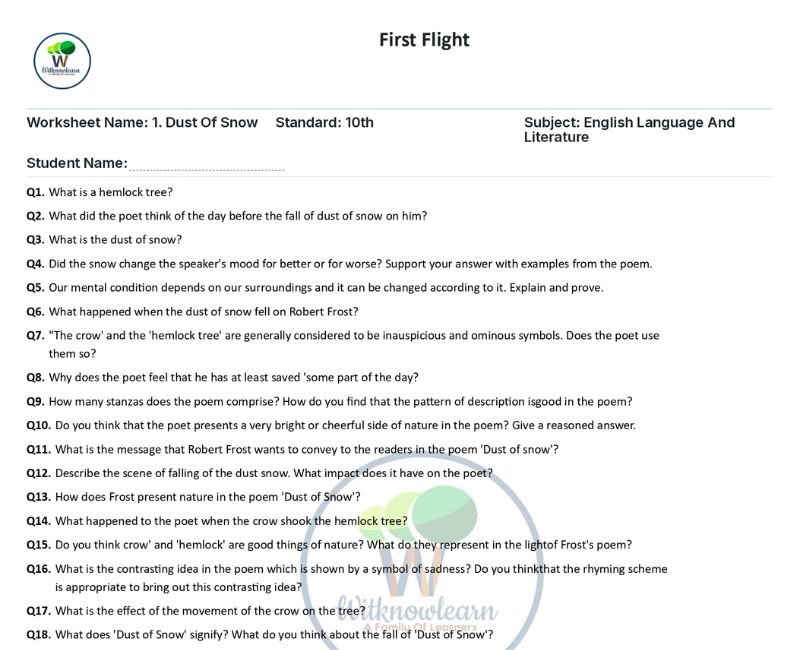
How can a brief encounter with nature change the way someone experiences the rest of a day? Use the Dust of Snow Class 10 worksheet with answers to practise interpreting the speaker’s mood, Robert Frost’s choice of images and the significance of a small event.
Attempt the questions independently before checking the answers. Read the poem closely, select relevant evidence and explain how its language supports your interpretation.
Build Poetry Skills through Focused Practice
“Dust of Snow” is a short poem, but its compressed language offers several opportunities for thoughtful reading. Worksheet practice helps you move from identifying what happens to explaining why the moment matters.
The mixed English practice format supports short and long-answer work, extract-based questions, objective responses and vocabulary activities. For poetry, pay particular attention to mood, imagery, sound and the relationship between the two stanzas.
Identify the task before answering. A question about an image needs its meaning; a question about its significance needs an explanation of its contribution to the poem.
Trace the Speaker’s Change of Mood
Questions about mood require you to compare the speaker’s earlier state with the effect of the falling snow. Explain the change through the poem’s wording rather than inventing a reason for the original unhappiness.
Distinguish what the poem states from what you infer. The speaker indicates regret about the day, but the poem does not provide a detailed account of the events causing that feeling.
A strong response explains how the unexpected interruption changes the speaker’s outlook. Keep the extent of that change accurate: the poem refers to rescuing part of the day, rather than erasing every difficulty.
Practice Prompt: Read a Small Detail Carefully
Question: Why is the reference to saving only part of the day important?
Answer approach: Explain how the improvement remains limited but meaningful. Connect the detail with the poem’s suggestion that a small change can still have value.
Interpret the Crow and the Hemlock Tree
Questions about the bird and tree invite you to examine the poet’s choice of unexpected natural elements. Consider how they differ from conventionally cheerful images used to celebrate nature.
School interpretations often associate these choices with a sombre atmosphere. A careful answer presents this as an interpretation and then explains the contrast with the positive effect of the incident.
Avoid treating the crow as deliberately trying to improve the speaker’s mood. The poem describes an event and its effect, not a confirmed intention on the bird’s part.
Separate the Literal Event from Symbolic Meaning
First explain what happens in the scene. Then discuss what the imagery may suggest. This prevents an interpretation from replacing the poem’s actual event or assigning a fixed meaning to every natural object.
Read the Title in Relation to the Whole Poem
A title question should connect the fine particles of snow with the emotional change they trigger. Explain how something physically small becomes important through its effect on the speaker.
Do not stop at defining the words in the title. Show how the title directs attention towards the brief, ordinary incident at the centre of the poem.
For an inference about the message, connect this scale of event with the scale of change. The poem can support an interpretation about unexpected sources of renewal without suggesting that every problem has an instant solution.
Answer Poetry Extracts with Precision
Read the extract in relation to the complete poem. Identify whether the lines describe the incident or its effect, and notice how the sentence develops across line breaks.
For extract-based MCQs, compare all options with the wording. For True/False tasks, check the entire statement. For fill-in-the-blank questions, use an answer that fits both meaning and grammar.
Vocabulary questions require contextual reading. If asked about a word expressing regret, explain its meaning within the speaker’s experience rather than giving an unrelated dictionary definition.
A Routine for Poetry Extract Questions
- Read the lines as part of a complete sentence.
- Identify the action, feeling or image being discussed.
- Read the question’s exact demand.
- Select a relevant word or detail.
- Explain its meaning or effect when required.
When instructed to identify a word from the extract, provide the word appearing there rather than substituting a synonym.
Explain Poetic Devices with Their Effects
For a device question, identify the feature, give a brief textual example where required and explain its effect. Naming a device alone does not fully answer a question asking how language works.
Check rhyme through the sounds of the line-ending words. For alliteration, look for repeated initial consonant sounds. For enjambment, examine whether the sentence continues into the next line without a grammatical stop.
Avoid labelling every image as a metaphor. Determine whether the language is literal, figurative or open to symbolic interpretation before choosing a term.
| Question Area | Skill Developed | Answer-Writing Focus |
|---|---|---|
| The falling snow | Literal comprehension | Describe the event accurately. |
| The speaker’s mood | Inference and comparison | Explain the before-and-after contrast. |
| Crow and hemlock imagery | Interpretation | Discuss the unexpected choices and their effect. |
| The title | Connecting detail and theme | Explain the significance of a small incident. |
| Rhyme and sound | Recognition of form | Use the line endings and repeated sounds as evidence. |
| The central message | Supported judgement | Connect the interpretation with the poem’s limits and details. |
Write Clear Short and Extended Responses
For a short answer, state the point, include a relevant detail and explain the connection. Follow the word limit given in the question. A concise interpretation is stronger than repeating the entire poem in prose.
For an extended answer, organise two or three connected ideas. A response about nature might discuss the ordinary setting, unexpected imagery and emotional effect. A response about the mood change should explain its cause and significance.
Keep personal examples brief when a task invites them. Explain the connection with the poem rather than allowing the example to replace literary analysis.
Use the Answers to Improve Your Reading
Complete the worksheet before consulting the answers. Compare meaning, evidence and reasoning rather than expecting identical wording.
- Check accuracy: have you described the incident correctly?
- Check inference: have you invented a cause for the speaker’s regret?
- Check devices: does your example demonstrate the term you named?
- Check expression: are your sentences clear and complete?
Rewrite responses where the interpretation is plausible but unsupported. Teachers can use the worksheet after a reading aloud, allowing students to notice sound and sentence flow before writing independently.
Related Interpretation Practice
For another example of a small experience changing a character’s emotional response, try the Madam Rides the Bus Class 10 worksheet with answers.
Compare the direction and cause of the mood changes, supporting your response with details from each text.
Frequently Asked Questions About Dust of Snow
Who wrote Dust of Snow?
Robert Frost wrote “Dust of Snow”. The poem presents a brief natural incident and its effect on the speaker.
What does the title Dust of Snow mean?
It refers to fine particles of snow falling from the tree. Their small physical size contrasts with the meaningful change they bring to the speaker’s mood.
How does the speaker’s mood change?
The incident interrupts a regretful or unhappy state and improves the speaker’s outlook, allowing part of the day to feel worthwhile.
Why does Frost choose a crow and a hemlock tree?
They are unexpected choices for a moment of renewal. Their commonly sombre associations make the positive effect more striking, showing that uplifting experiences need not come from conventionally cheerful images.
Does the poem explain why the speaker was unhappy?
No. It indicates regret about the day without specifying the events behind it. Avoid inventing a cause in your answer.
What is the rhyme scheme?
The rhyme scheme is ABAB in the first stanza and CDCD in the second. Identify the pattern through the sounds of the line-ending words.
What does enjambment contribute to the poem?
The sentence continues across line breaks, linking the incident with its emotional effect. This gives the short lines a connected flow.
What is the central message of Dust of Snow?
The poem suggests that an ordinary, unexpected moment can improve a person’s outlook. Even a limited positive change can rescue part of an otherwise regretted day.
 Download