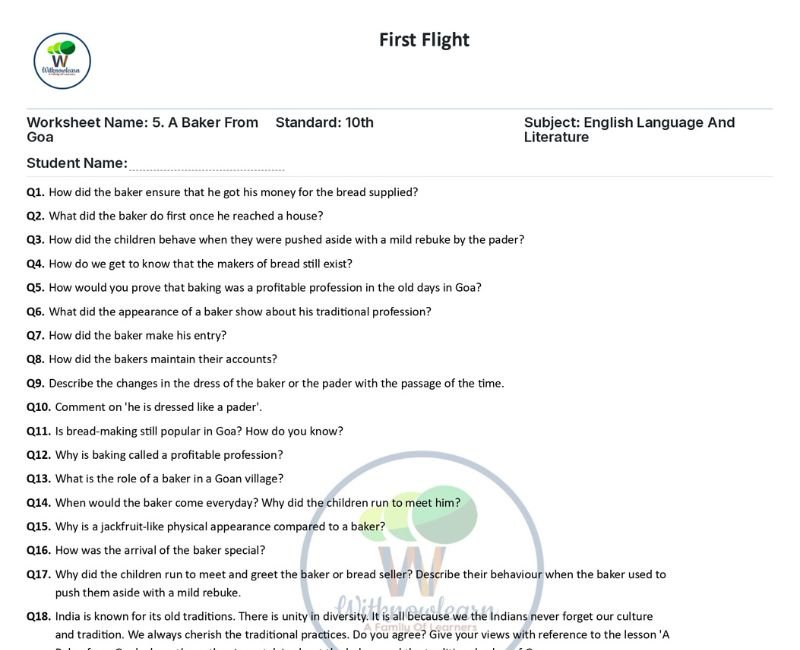
A Baker from Goa Class 10 Worksheet with Answers
What makes the baker more than a bread seller? Why do his visits remain vivid in the narrator’s childhood memories? Use the A Baker from Goa Class 10 worksheet with answers to practise explaining community traditions, nostalgia and the importance of everyday details.
Attempt the questions independently, then consult the answers to check your understanding. Focus on accurate details, relevant evidence and clear explanations rather than memorising complete responses.
Practise the Goan Account in Detail
“A Baker from Goa” by Lucio Rodrigues is the first part of “Glimpses of India” in First Flight. This worksheet gives students an opportunity to concentrate on the Goan section, including the baker’s visits, clothing, livelihood and place in local customs.
The mixed English practice format brings together short and long-answer work, extract-based questions, objective responses and vocabulary activities. These tasks help develop both close reading and the ability to explain the significance of a detail.
Identify the instruction before writing. A question asking what the baker wore requires a precise description; one asking why the baker was important requires reasons supported by examples.
Explain the Baker’s Place in Community Life
Questions about the baker’s importance should connect his occupation with daily routines and special occasions. Select examples that show how baked foods are woven into the community’s customs.
A strong answer explains the relationship between regular demand and the baker’s continued presence. Avoid stopping at a general statement such as “bread was popular” when the question asks about cultural importance.
For longer responses, group your evidence into everyday needs and ceremonial uses. This organisation helps you develop a clear argument without repeating the same point.
Practice Prompt: Explain Why a Profession Endures
Question: How does the passage show that baking survives because it is closely connected with Goan life?
Answer approach: Use examples of household routines and celebrations, then explain how these continuing needs support the profession. Connect the evidence with the survival of the tradition.
Read Childhood Memories for Tone and Meaning
The narrator’s recollections provide useful practice in identifying nostalgia. Examine the familiar sounds, the children’s eagerness and the descriptions of the baker’s arrival.
If asked why the visits mattered to the children, distinguish their interest from the adults’ purpose. This prevents an answer from treating everyone in the household as having the same expectation.
For questions about the baker as a familiar figure, explain how repeated contact creates closeness. Support your answer with the routine described in the passage rather than inventing conversations or incidents.
Answer Extract-Based Questions Accurately
Before responding to an extract, identify whether it concerns the survival of baking, a childhood visit, a celebration, clothing or accounts. The context helps you choose the correct evidence.
For passage-based MCQs, compare every option with the text. For True/False statements, check words that change the claim, such as “only”, “always” or “never”. For fill-in-the-blank questions, ensure the answer fits the information and the grammar.
Vocabulary questions should be answered in context. Words connected with memory, livelihood and appearance may carry a specific meaning in the passage.
A Checklist for Extract Practice
- Identify the subject of the passage.
- Read the exact demand of the question.
- Locate the supporting word or detail.
- Answer directly, adding an explanation when required.
- Check that the response stays within the evidence.
When instructed to find a word from the extract, use the word appearing there rather than supplying a different synonym.
Distinguish Continuity from Change
The passage moves between recollections of earlier times and signs that the baking tradition continues. Questions comparing past and present require you to keep these references separate.
Explain what has endured, such as the occupation and its connection with local life, while recognising changes in details like clothing. Do not assume that the survival of a tradition means every practice remains identical.
This distinction also helps with questions about Portuguese influence. Focus on how the passage presents a lasting bread-making tradition rather than suggesting that the earlier political rule continues.
Interpret Clothing, Accounts and Prosperity
Descriptions of the baker’s clothing and appearance are useful for factual and inferential questions. Give the requested detail first, then explain its significance if the task asks for interpretation.
Questions about payment records test close reading of the baker’s working routine. Questions about prosperity ask you to connect the narrator’s observations with the success of the occupation.
Keep the interpretation within the account. A description of the baker’s physique reflects the narrator’s portrayal; it should not be turned into a universal claim about health or wealth.
| Question Topic | Skill to Practise | Answer-Writing Focus |
|---|---|---|
| The baker’s daily visits | Accurate recall | State the routine and explain its relevance when asked. |
| The children’s response | Understanding motivation | Distinguish their interest from the adults’ needs. |
| Bread and celebrations | Cultural interpretation | Use specific examples to explain importance. |
| Clothing and appearance | Description and inference | Separate the stated detail from its suggested meaning. |
| Nostalgia and familiar sounds | Recognising tone | Explain how details make the memory affectionate and vivid. |
| Survival of the tradition | Comparison and reasoning | Connect continuing demand with cultural continuity. |
Develop Focused Short and Long Answers
For short answers, state the main point, include a relevant detail and explain the connection. Follow the word limit given in the question. Avoid writing the whole account when only one custom or observation is required.
For longer responses, organise two or three connected ideas. An answer about nostalgia can examine sound, routine and childhood excitement. An answer about cultural identity can connect food, celebrations and a familiar occupation.
Check that your response explains why the evidence matters. A list of correctly remembered details is useful, but interpretation requires a link between those details and your main point.
Keep This Worksheet Focused on Goa
“A Baker from Goa” belongs to the larger chapter “Glimpses of India”. Use Coorg or Assam only when the question explicitly asks for a comparison. Otherwise, select evidence from the Goan account.
Use the Answers to Strengthen Independent Practice
Finish your first attempt before checking the answers. Compare meaning and evidence rather than expecting identical wording.
- Check details: have you confused clothing, food items or routines?
- Check relevance: does the answer address the exact question?
- Check reasoning: have you explained the importance of your example?
- Check expression: are your sentences clear and complete?
Rewrite answers that contain a correct detail but an incomplete explanation. Teachers can use the worksheet for homework, classroom comprehension or discussion followed by individual written responses.
Related Revision and Practice
Review the Goan section through Glimpses of India Class 10 questions and answers, then return to this worksheet for independent practice.
For questions connecting Goa, Coorg and Assam, use the Glimpses of India Class 10 worksheet with answers.
Frequently Asked Questions About A Baker from Goa
Who wrote A Baker from Goa?
Lucio Rodrigues wrote “A Baker from Goa”. It appears as Part I of “Glimpses of India” in First Flight.
What is the traditional baker called in Goa?
The baker is known as a pader in the passage.
Why did the children eagerly meet the baker?
They looked forward to the bread-bangles and chose them eagerly. Their excitement makes the baker’s visits an important childhood memory.
How did the baker announce his arrival?
The distinctive sound of his bamboo staff announced his arrival. The familiar sound became part of the household’s morning routine.
What was the kabai?
It was a long, single-piece garment reaching down to the knees, described as the baker’s clothing in earlier times.
Why was baking considered a profitable profession?
The passage presents baked foods as regularly needed for households and celebrations. The narrator also describes bakers and their households as prosperous.
How were the baker’s monthly accounts recorded?
The accounts were written on a wall in pencil, and the payment was collected at the end of the month.
What evidence shows that the baking tradition continued?
The passage refers to surviving furnaces, practising bakers and the familiar sound announcing their arrival. These details show continuity beyond the period recalled by the elders.
 Download