Fog Class 10 Worksheet with Answers
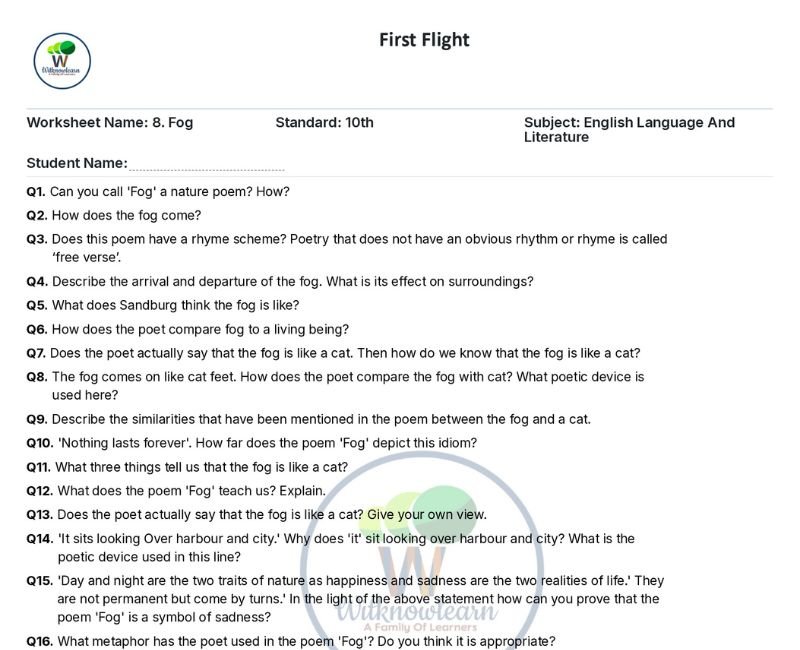
How can a familiar animal help us picture a change in the weather? Carl Sandburg’s Fog offers a memorable opportunity to explore that question. This Fog Class 10 worksheet with answers supports close reading, interpretation and clear answer writing through focused poetry practice.
Read the poem, attempt the questions independently and review your responses using the answers. Pay particular attention to how a few carefully chosen words create a complete scene.
Practise Reading a Short Poem Closely
A brief poem rewards careful attention. Students should examine individual words, the order of actions and the connections between images. Use this worksheet to practise explaining your observations in your own language.
Following WitKnowLearn’s English worksheet approach, work through the questions before checking the answers. Apply the same care to objective tasks, vocabulary activities, extract-based questions and written responses. A correct option matters, but understanding why it is correct makes your revision more useful.
For your first attempt, keep the textbook open and mark the detail that supports each response. On your second attempt, answer selected questions from memory and then check the accuracy of your evidence.
Fog Poem Questions: Skills to Develop
Explain the Cat Metaphor
The poem presents fog through the image of a cat. Practise explaining the comparison rather than stopping after naming the animal. Identify a shared quality, select a supporting detail and show how it helps the reader imagine the fog.
A useful answer has three parts: the comparison, its evidence and its effect. This structure helps you respond to questions asking why the image is appropriate or effective.
Trace Arrival, Stillness and Departure
Follow the sequence of actions as you read. Divide your rough work into three stages and note the detail associated with each. This simple activity helps you organise a response about movement without repeating the entire poem.
When the question focuses on a particular stage, select only the evidence needed for that stage. If it asks about the whole comparison, connect the stages in a logical order.
Describe the Mood with Evidence
Choose a mood word and test it against the language of the poem. Ask yourself which detail supports your choice. An explanation becomes stronger when it shows how the wording creates an impression.
Try writing two versions of a response: one that merely names the mood and another that explains it. Compare them to see how evidence makes the second answer more convincing.
Understand Vocabulary in Context
For vocabulary questions, read the surrounding phrase before selecting a meaning. Consider how the word contributes to the image, then express its meaning in simple language.
Use the same method for synonyms and fill-in-the-blank tasks. Check both meaning and grammar. A word may have a similar dictionary meaning but still be unsuitable in the sentence provided.
Discuss Form and Word Choice
Fog is written in free verse. For a question about form, explain that it does not follow a fixed rhyme scheme. For a question about word choice, focus on the particular expression supplied in the task.
Keep your discussion precise. Naming a feature is the first step; explaining its relevance completes the answer. Avoid listing several poetic devices when the question asks you to examine one example.
Example Practice Prompt
Question: How does the animal comparison make the description of fog easier to visualise?
Answer approach: Identify the animal, choose one quality shared with the fog and explain the picture it creates. Add another detail only if it develops your explanation.
After writing, underline the sentence that answers the question directly. Then check whether your evidence supports that sentence. If the connection is unclear, revise the explanation before adding more words.
Approach Fog Extract-Based Questions Carefully
For Fog extract-based questions Class 10, begin with the passage supplied. Read the question before deciding which detail matters. A task may ask about reference, inference, vocabulary or imagery, even when the extract is familiar.
A Four-Step Extract Strategy
- Identify the task: Decide whether you need to name, explain, interpret or select an answer.
- Locate the detail: Find the word or action that directly relates to the question.
- Check the connection: Make sure your response follows from the extract.
- Answer precisely: Include enough explanation to complete the task while keeping your response focused.
For MCQs, compare all options before choosing. For True or False statements, identify the evidence that confirms the statement or the detail that needs correction.
Plan Your Fog Worksheet Practice
| Practice Area | Skill | Self-Check |
|---|---|---|
| Factual questions | Accurate recall | Have you supplied exactly the information requested? |
| Metaphor questions | Explaining a comparison | Have you connected a shared quality to the poem? |
| Extract-based MCQs | Reading evidence closely | Can you explain why your option fits? |
| Vocabulary activities | Understanding context | Does your meaning fit the surrounding phrase? |
| Short written responses | Concise explanation | Does each sentence contribute to the answer? |
| Extended or comparison tasks | Developing connected ideas | Have you supported each main point with evidence? |
Write Clear Short and Extended Answers
For Fog Class 10 short questions and answers, open with the requested point. Follow it with a relevant explanation and observe any word limit given in the task. Read the question again before finishing to ensure that you have addressed every part.
For an extended response, prepare a short plan. Decide on your main idea, select two supporting observations and arrange them in a sensible order. Develop the explanation through the poem’s language rather than repeating your opening statement.
When comparing poems, use one clear basis for comparison, such as the treatment of nature or the effect of an image. Include evidence from both texts and explain the connection. This produces a more focused response than two separate summaries.
Review Answers through Explanation
Use the answer key to check accuracy and reasoning. Your wording can differ while expressing the same supported idea. Look for a direct answer, suitable evidence and a clear connection between them.
Keep a small correction list with three headings: detail to remember, explanation to improve and word to revise. Return to this list before your next practice session.
Continue Your Class 10 Poetry Practice
Explore the Dust of Snow worksheet with answers to practise explaining how a brief natural scene can carry meaning. Choose a question from each poem and compare the evidence you need.
Use The Trees Class 10 worksheet with answers for further work on imagery and movement. Practise describing how each poet helps the reader visualise nature.
Frequently Asked Questions about Fog Class 10
Who is the poet of Fog?
Carl Sandburg wrote Fog. It is studied in the Class 10 English textbook First Flight.
What is fog compared to in the poem?
Fog is compared to a cat. The comparison connects its quiet arrival, temporary stillness and departure with a cat’s behaviour.
Why is the cat metaphor appropriate?
A cat can approach quietly, pause and move away without attracting much attention. These qualities help the reader picture the fog’s movement.
What does “it” refer to in the poem?
“It” refers to the fog, which the poet describes through the extended cat image.
What does the fog look over?
The fog looks over the harbour and the city. This gives the reader a clear setting for the image.
What does “haunches” mean?
Haunches are an animal’s hindquarters, including its hips and upper hind legs. The word evokes a cat’s seated posture.
Does Fog have a fixed rhyme scheme?
No. The poem is written in free verse and does not follow a fixed rhyme scheme.
How can I practise Fog questions and answers effectively?
Attempt factual and interpretive questions, support your responses with details and review them using the answers. Rewrite one weak explanation before moving to another task.
 Download