100 Unseen Passages for Class 10 with Answers PDF 2026
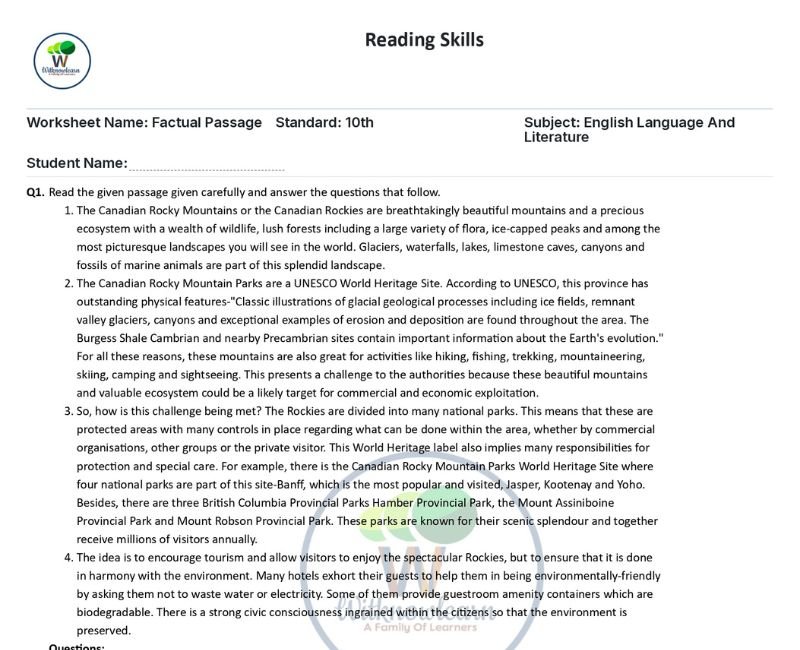
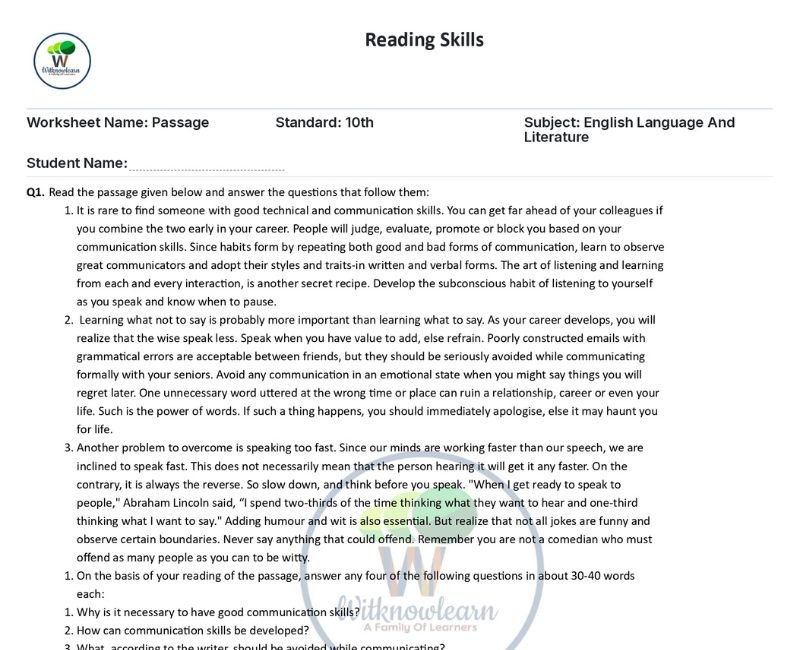
Make independent reading part of your study routine with WitKnowLearn’s 100 unseen passages for Class 10 with answers PDF. This collection gives Grade 10 learners a substantial bank of material for practising comprehension and reviewing their responses.
Use it for classroom activities, homework or personal revision. Read a passage, attempt its questions and consult the answers to understand where your reasoning is accurate and where it needs attention.
A Reading Resource for Grade 10 Students Across Boards
Students following different school boards can use this collection for general English comprehension practice. Finding relevant information, interpreting ideas and understanding vocabulary are useful reading skills across learning contexts.
Choose passages and tasks that suit your current learning goals. Your teacher can help you decide which activities complement your school’s assessment requirements. Use the instructions attached to each question to guide the length and form of your response.
The value of a large collection comes from how you use it. Treat the passages as opportunities to strengthen different skills, rather than a list to finish as quickly as possible. Careful review can reveal more than the number of questions answered correctly.
What to Look for While Reading
Separate the Topic from the Main Point
The topic tells you what a passage discusses. The main point explains what the writer says about that topic. Practise recording both in your rough work.
For example, a passage may discuss school gardens, while its main point concerns how shared responsibility helps a project succeed. This distinction helps you answer questions about suitable titles, central ideas and the writer’s purpose.
Notice How Paragraphs Connect
Ask what each paragraph contributes. Does it introduce an idea, provide an example, explain a difficulty or suggest a response? Recognising these functions helps you follow the writer’s reasoning.
Look closely at connecting words. Expressions that introduce contrast, sequence or consequence can change how two statements relate to each other. Use those connections when explaining the passage.
Distinguish a Claim from Its Evidence
When the writer makes a claim, identify the example, observation or explanation used to support it. This prepares you for questions that ask how an argument is developed.
Write the claim and its supporting detail beside each other. Then explain the relationship in one sentence. This short exercise helps you avoid repeating evidence without showing why it matters.
Track Reference Words
Words such as “this,” “they” and “it” connect sentences. Return to the preceding lines to work out what they refer to. Check that your interpretation fits the sentence grammatically and logically.
Resolving these references is especially useful when a passage discusses several people, ideas or events. A small misunderstanding can affect your interpretation of the paragraph.
Read Unfamiliar Words through Context
You can often understand an unfamiliar expression by examining nearby examples or explanations. First decide what meaning would make sense in the sentence, then compare it with the available options or the answer requested.
Keep a vocabulary record containing the word, its meaning in that passage and a sentence of your own. This helps you connect vocabulary learning with actual usage.
Turn 100 Passages into a Personal Learning Plan
Divide your work into sets of ten passages. Give each set a learning priority, such as finding evidence, making inferences or improving concise answers. This is a suggested study arrangement; you can adapt it to your schedule.
Begin each set with a clear goal. At the end, look back at your corrections and decide whether the skill has improved. If the same difficulty remains, practise it deliberately in the next set.
| Practice Stage | Main Goal | Evidence of Progress |
|---|---|---|
| Starting sessions | Understand the overall meaning | You can state the central idea clearly. |
| Evidence practice | Locate relevant supporting details | You can show where each answer comes from. |
| Interpretation practice | Explain implied meaning | Your conclusions follow from textual clues. |
| Language practice | Understand words and references | You can explain meaning in context. |
| Timed sessions | Balance pace and accuracy | You complete tasks with fewer rushed errors. |
| Review sessions | Apply corrections independently | You handle a similar task more confidently. |
Original Comprehension Example
Practise Drawing a Supported Conclusion
Mini passage: Volunteers planted saplings in a neighbourhood park. During the first week, many residents helped with watering. A month later, only a few continued regularly. The volunteers introduced a weekly duty chart so that each participating family knew when to help.
Question: What problem was the duty chart intended to address?
Sample answer: The chart was intended to make watering more consistent by assigning clear responsibilities, as participation had become less regular after the first week.
Why this works: The response identifies the difficulty and connects it to the action taken. It explains the relationship instead of repeating the final sentence alone.
Make Better Use of the Answers
A collection of unseen passages with questions and answers for Class 10 is most useful when you attempt the work first. Afterwards, compare your response with the answer and identify the reason for any difference.
For a wrong objective answer, explain why your chosen option fails to fit the passage. For a written answer, check whether you omitted a detail, changed the meaning or left your reasoning unclear.
Your wording may differ from the answer key. Evaluate whether it communicates the same supported meaning and completes the task. Rewrite a weak answer once, then test the improved method on another question.
Keep a Useful Error Record
Record mistakes under three simple headings: reading, reasoning and expression. A missed fact belongs under reading; an unsupported conclusion belongs under reasoning; an unclear sentence belongs under expression.
Choose one recurring issue to address in your next session. This gives your practice a specific purpose and makes improvement easier to notice.
Build Speed after Establishing Accuracy
First develop a dependable reading method. Once you can locate evidence and answer accurately, introduce timed practice. Record the time needed for reading, answering and checking so that you can see where delays occur.
If one question takes too long, mark it and return after completing the others. Before finalising the task, check question numbers, missing parts and any instructions about the number of responses required.
Ideas for Teachers and Independent Learners
Teachers can use selected passages for individual work followed by an evidence discussion. Ask students to explain where they found an answer or why they rejected an option. This makes their reading process visible.
Independent learners can complete a passage, review it and write a short reflection: one thing understood well and one thing to practise next. Over several sessions, these reflections create a practical record of progress.
Explore More English Practice
Visit the A Letter to God worksheet with answers for additional practice in interpreting motives and supporting explanations.
If you also want a separately labelled CBSE resource, explore 50 unseen passages for Class 10 with answers CBSE.
FAQs about 100 Unseen Passages for Class 10
Who can use this Class 10 unseen passage collection?
Grade 10 students across school boards can use it for general English reading practice. Teachers can select tasks that suit their learners and classroom goals.
Does the resource contain 100 passages with answers?
Yes. This resource offers a collection of 100 unseen passages with answers for comprehension practice and review.
How is this different from a chapter worksheet?
A chapter worksheet builds on a text studied beforehand. An unseen passage asks you to understand an unfamiliar text and answer using the information provided.
Can these passages help with vocabulary?
Yes. Use unfamiliar words as opportunities to examine context, record meanings and practise using the words in your own sentences.
How many passages should I attempt each day?
Choose a manageable amount that leaves time for correction. Start with one passage per session and adjust according to its length, difficulty and your schedule.
What should I do when an answer is not stated directly?
Look for connected clues and draw a reasonable inference. Check that the passage supports your conclusion before writing it.
Should I memorise the answers?
Use the answers to understand the reasoning and improve your method. Practise applying that method to a different passage.
Can teachers use the PDF for homework?
Teachers can assign selected passages for homework, revision or classroom discussion. Choose activities according to students’ needs and review the evidence behind their responses.
 Download