Glimpses of India Class 10 Worksheet with Answers
A baker’s morning visit, the landscape of Coorg and a journey through Assam’s tea country offer three different ways of discovering India. Use the Glimpses of India Class 10 worksheet with answers to practise reading these accounts closely and explaining their cultural significance.
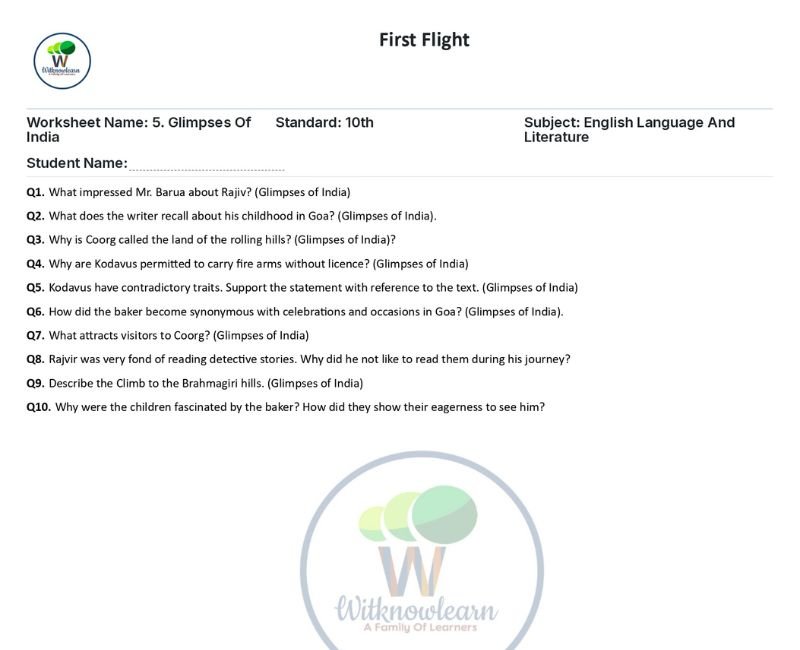
Work through comprehension, extract-based questions, vocabulary and written responses. Attempt each task independently before checking the answers, paying attention to which part of the chapter the question concerns.
Practise All Three Parts of Glimpses of India
“Glimpses of India” contains “A Baker from Goa” by Lucio Rodrigues, “Coorg” by Lokesh Abrol and “Tea from Assam” by Arup Kumar Datta. Each section presents a distinct place through its people, traditions, surroundings or everyday activities.
This worksheet follows a mixed English practice format, combining short and long-answer work with passage-based tasks, objective responses and vocabulary activities. The variety helps you practise accurate recall alongside inference, comparison and explanation.
Before writing, identify the section and the task word. A question about a custom requires a different response from one asking how descriptive language creates an impression of a place.
A Baker from Goa: Explain Tradition through Details
Questions on “A Baker from Goa” often ask you to connect the baker’s work with community life. Use details about visits, food and celebrations to explain why the occupation matters beyond the sale of bread.
When discussing the narrator’s childhood memories, examine the sounds, routines and expectations that make the recollection vivid. Explain how these details reveal familiarity and affection.
Distinguish memories of the past from observations about the continuation of the tradition. A careful answer identifies what has survived rather than assuming that every aspect of life remains unchanged.
Practice Prompt: Connect Occupation and Culture
Question: How does the baker’s role show that food can be part of a community’s cultural identity?
Answer approach: Select relevant details about daily life and special occasions. Explain how repeated customs give the baker a place in the community’s shared experience.
Coorg: Support Descriptive Answers with Evidence
For questions on Coorg, organise details according to the demand: location, landscape, people, traditions, wildlife or activities. Avoid putting every remembered fact into a short answer.
When asked how the writer makes the place attractive, connect the selected descriptions with their effect on the reader. Explain how references to natural surroundings and outdoor experiences create interest.
The passage also discusses accounts of the people’s ancestry. Present these as possibilities or traditions mentioned in the text, rather than as conclusively established historical facts.
Tea from Assam: Compare Knowledge and Experience
Questions on “Tea from Assam” offer opportunities to compare Rajvir’s curiosity with Pranjol’s familiarity. Explain how their different experiences influence their reactions during the journey.
For questions about tea legends, distinguish a traditional story from a verified explanation. Retell only the details needed by the question and make clear that the account is presented as a legend.
When answering about the plantation, use the descriptions and conversation to explain what Rajvir notices or learns. Keep the characters and setting separate from those in the other two sections.
Keep Legends, Observations and Facts Distinct
Use phrases such as “the legend describes” or “the passage suggests” where appropriate. This helps you preserve the text’s meaning without turning a possibility or traditional account into a confirmed fact.
Read Extracts for Context and Language
Identify the section before answering a passage-based question. Then locate the speaker or narrator, the situation and the detail that supports your response.
For extract-based MCQs, compare every option with the passage. For True/False statements, check qualifiers that alter the meaning. For fill-in-the-blank tasks, ensure the response fits both the information and the grammar of the sentence.
Vocabulary and synonym questions require contextual reading. A word describing a memory, landscape or reaction may have several meanings, but only one will fit the passage.
| Section | Reading Focus | Answer-Writing Skill |
|---|---|---|
| A Baker from Goa | Childhood memories, food customs and continuity | Explain cultural importance using specific examples. |
| Coorg | Landscape, people and descriptive detail | Select and organise evidence about a place. |
| Tea from Assam | Curiosity, conversation, legends and plantations | Compare viewpoints and distinguish types of information. |
| Across all three parts | Regional identity and shared connections | Develop a supported comparison without writing three summaries. |
Answer Comparative Questions Clearly
A comparison should use a common basis. If asked how the chapter presents regional identity, examine how each section connects a place with distinctive practices or surroundings.
Build the response around similarities and differences. For example, consider how everyday activities communicate culture, while recognising that one section uses personal recollection, another descriptive presentation and another a travel conversation.
Use details from every section required by the question. Giving a detailed answer about Goa and only naming Assam does not create a balanced comparison.
Practice Prompt: Explain the Chapter Title
Question: Why is “Glimpses of India” an appropriate title for these three accounts?
Answer approach: Explain that each section offers a selective view of a region. Support this with one relevant feature from each part and connect the variety with the chapter’s wider presentation of India.
Improve Short and Long Answers
For short answers, begin with the requested point and support it with a useful detail. Follow the word limit stated in the task. Avoid adding information about a region that the passage does not provide or the question does not require.
For longer responses, group related points before writing. An answer about tradition can connect daily routines and celebrations; an answer about regional diversity can compare the three sections using a consistent focus.
Read your response once for content and once for expression. Check names, section titles, sentence structure and the distinction between explanation and retelling.
Use the Answers for Active Revision
Complete the worksheet before consulting the answers. Compare the meaning and supporting evidence, recognising that clear wording of your own can be equally valid.
- Check section accuracy: have you mixed details from Goa, Coorg and Assam?
- Check selection: does each detail answer the question?
- Check reasoning: have you explained the significance of your evidence?
- Check comparison: have you addressed all the parts requested?
Rewrite responses where a detail is correct but its importance remains unexplained. Teachers can use the worksheet for homework, classroom comprehension or group discussion followed by independent writing.
Related Chapter Revision
Review the textbook responses through Glimpses of India Class 10 questions and answers, then return to the worksheet to practise without assistance.
For further work on personal recollection and a narrator’s viewpoint, try the From the Diary of Anne Frank Class 10 worksheet with answers.
Frequently Asked Questions About Glimpses of India
What are the three parts of Glimpses of India?
They are “A Baker from Goa”, “Coorg” and “Tea from Assam”. Each presents a different regional perspective.
Why is the baker important in Goan life?
Bread and other baked foods are connected with daily routines and important celebrations. The baker therefore participates in both household life and community customs.
What is a pader, and what is a kabai?
A pader is the traditional baker referred to in the Goan account. A kabai is the long, single-piece garment described as reaching down to the knees and worn by bakers in earlier times.
How does the narrator recognise the baker’s arrival?
The distinctive sound of the baker’s bamboo announces his arrival. This familiar sound forms part of the narrator’s childhood memories.
Where is Coorg located?
Coorg, also known as Kodagu, is in Karnataka. The chapter places it between Mysore and the coastal town of Mangalore.
Are the accounts of Coorg’s Greek or Arab ancestry certain facts?
The chapter presents possible accounts of ancestry, supported by references to appearance, customs or clothing. Describe them as accounts mentioned in the passage rather than proven conclusions.
Why is Rajvir more excited by the tea gardens than Pranjol?
The plantations are a new experience for Rajvir, who is curious about tea. Pranjol has grown up around them, so the surroundings are familiar to him.
How should I answer a question comparing all three regions?
Choose the common focus given in the question, such as culture or regional identity. Use a relevant detail from each section and explain the similarities or differences through connected points.
 Download