Tea from Assam Class 10 Worksheet with Answers
A train journey becomes an opportunity to discover tea gardens, exchange stories and connect reading with experience. Use the Tea from Assam Class 10 worksheet with answers to practise explaining Rajvir’s curiosity, Pranjol’s reactions and the details that make the plantation visit memorable.
Attempt the questions independently before consulting the answers. Focus on accurate comprehension, evidence-supported interpretation and clear written responses.
Practise the Assam Section in Detail
“Tea from Assam” by Arup Kumar Datta is the third part of “Glimpses of India” in First Flight. Its travel setting and conversation offer opportunities to examine character, descriptive language and different kinds of information.
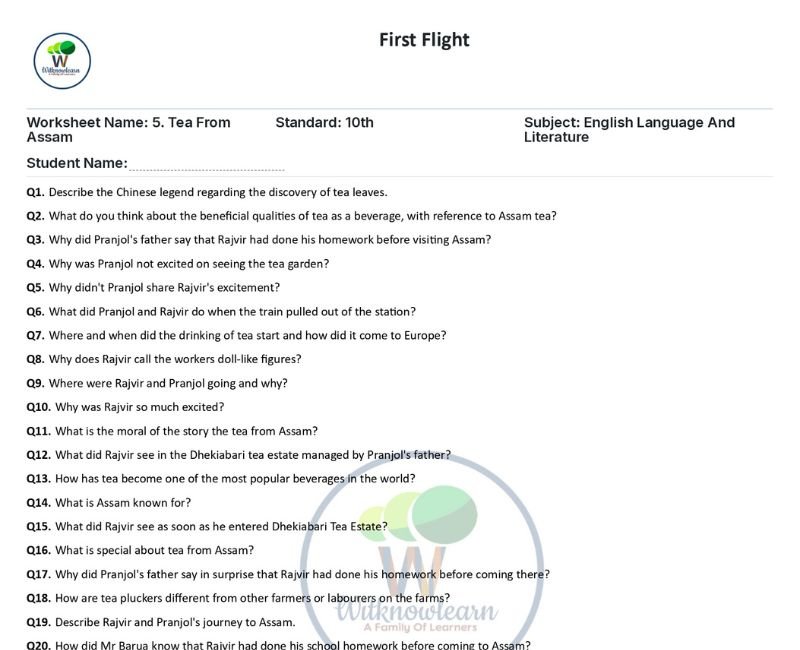
The worksheet follows a mixed English practice format, bringing together short and long-answer work, extract-based questions, objective responses and vocabulary activities. Use each type of task to strengthen a specific skill.
Read the instruction before answering. A question asking where the boys are going requires a precise detail. A question asking what Rajvir’s behaviour reveals requires an inference supported by his actions or conversation.
Compare Rajvir’s Curiosity with Pranjol’s Familiarity
Questions comparing the two friends require more than saying that one is excited and the other is not. Explain how their different experiences influence their responses to the surroundings.
Rajvir’s observations and questions provide evidence of interest. Pranjol’s familiarity with tea country helps explain why the same sights do not produce an equally strong reaction in him.
A balanced comparison should discuss both characters using the same basis. Avoid treating Pranjol’s quieter response as proof that he dislikes his home or has no interest in tea.
Practice Prompt: Explain Different Reactions
Question: How does familiarity influence the way Rajvir and Pranjol respond to the tea gardens?
Answer approach: Identify what is new for Rajvir and familiar to Pranjol. Use a relevant observation or action from each character, then explain how experience shapes their reactions.
Read the Landscape Descriptions Closely
Descriptive questions ask you to select details and explain their effect. Examine how the view changes during the journey and how the tea bushes, shade trees and activity in the gardens create a picture of the region.
When asked about Rajvir’s fascination, connect the surroundings with his response. A list of landscape features becomes an interpretation only when you explain why those features matter to the question.
Keep the answer within the passage. Modern information about Assam’s tea industry is unnecessary when the task asks what the characters observe in the chapter.
Distinguish Tea Legends from Historical Information
The conversation includes traditional accounts of tea’s origins. Questions about these legends require accurate retelling, but your wording should preserve their status as legends.
If comparing the accounts, identify the central incident and the explanation each offers. Organise the response around a common focus instead of writing two unrelated summaries.
Questions about the relationship between legend and information can explore how the conversation makes tea interesting. Explain what the stories add while recognising that they do not establish a verified origin.
Choose Words That Match the Evidence
Use “according to the legend” when describing a traditional account. Use “Rajvir states” when reporting information from his conversation. This keeps your answer faithful to the text without presenting every statement as an independently verified fact.
Answer Extract-Based Questions with Precision
Before answering a passage-based task, identify whether the extract concerns the train journey, a tea legend or the arrival at the estate. Locate the speaker and the subject of the conversation.
For extract-based MCQs, compare every option with the passage. For True/False statements, check the whole claim, including words that alter its meaning. For fill-in-the-blank tasks, ensure your response fits both the information and the grammar.
Vocabulary and synonym questions should be answered through context. Test the proposed meaning in the sentence, especially when a word describes excitement, scenery or an agricultural activity.
A Routine for Passage-Based Practice
- Identify the situation and speaker.
- Read the exact demand of the question.
- Locate the supporting detail or expression.
- Answer directly, explaining the evidence where required.
- Check that you have not confused the passage with another part of Glimpses of India.
When instructed to find a word from the extract, give the word that appears there rather than supplying a different synonym.
Connect Preparation with Learning through Experience
Rajvir’s knowledge before the visit provides useful material for inference and value-based questions. Explain how his preparation influences what he notices and how he participates in the conversation.
A question about Pranjol’s father’s response should connect that response with the knowledge Rajvir demonstrates. Avoid simply repeating that the adult is surprised; explain what causes the surprise and what it suggests about Rajvir.
For a longer answer about curiosity, combine reading, observation and willingness to learn. Support the argument with relevant details rather than adding a general moral unrelated to the chapter.
| Question Area | Skill Developed | Answer-Writing Focus |
|---|---|---|
| The journey and destination | Accurate comprehension | Select the requested detail without unnecessary retelling. |
| Rajvir and Pranjol | Character comparison | Explain how their experiences shape their reactions. |
| Tea legends | Careful interpretation | Retain the distinction between a legend and a verified explanation. |
| Plantation descriptions | Analysis of descriptive language | Explain the impression created by selected details. |
| Rajvir’s preparation | Evidence-based inference | Connect prior knowledge with curiosity and engagement. |
| Vocabulary and expressions | Meaning in context | Choose a meaning that fits the passage. |
Organise Short and Long Answers Clearly
For a short response, state the main point, add a relevant detail and explain its significance. Follow the word limit given in the task. Avoid including both legends when only one is requested.
For a longer response, plan two or three connected points. A character sketch of Rajvir can discuss his enthusiasm, preparation and interest in learning. A comparison can explain the friends’ different reactions through their backgrounds.
Check that every sentence answers the question or supports your argument. Replace repeated events with clearer reasoning, and distinguish what the text states from what you infer.
Use the Answers to Improve Your Next Attempt
Complete the worksheet before checking the answers. Compare meaning and supporting evidence rather than expecting your wording to match exactly.
- Check names: have you confused Rajvir, Pranjol and Pranjol’s father?
- Check context: does the detail belong to the journey, legend or estate visit?
- Check reasoning: have you explained what the evidence reveals?
- Check expression: are your sentences clear and grammatically complete?
Rewrite responses where an accurate detail lacks an explanation. Teachers can use the worksheet for homework, classroom comprehension or discussion followed by independent writing.
Related Revision and Practice
Review the Assam section through Glimpses of India Class 10 questions and answers, then return to this worksheet for independent practice.
For questions connecting the three regional accounts, use the Glimpses of India Class 10 worksheet with answers.
Frequently Asked Questions About Tea from Assam
Who wrote Tea from Assam?
Arup Kumar Datta wrote “Tea from Assam”. It appears as Part III of “Glimpses of India” in First Flight.
Why were Rajvir and Pranjol travelling to Assam?
Pranjol had invited Rajvir to spend the summer holidays at his home in Assam. The journey gave Rajvir an opportunity to see tea country firsthand.
What was Pranjol’s father’s occupation?
He was the manager of a tea garden in Upper Assam. The boys visit Dhekiabari Tea Estate.
Why was Rajvir more excited by the scenery than Pranjol?
The tea gardens were a new experience for Rajvir. Pranjol had grown up in tea country, so the surroundings were familiar to him.
What does the Chinese legend say about tea?
According to the legend, leaves from burning twigs fell into an emperor’s boiling water and gave it a pleasing flavour. Present this as a traditional account rather than a confirmed historical event.
What is the legend associated with Bodhidharma?
The legend describes tea plants growing from his discarded eyelids after he cut them off to prevent sleep during meditation. Their leaves were then associated with keeping people awake.
What does Rajvir say about the second-flush period?
He identifies it as the period from May to July and associates it with the best tea. In a chapter answer, report this as information stated in the conversation.
What does Rajvir’s preparation reveal about him?
It shows curiosity and initiative. His prior reading helps him recognise details during the visit, while his willingness to learn shows that he remains open to further knowledge.
 Download