Footprints Without Feet Class 10 Worksheet with Answers
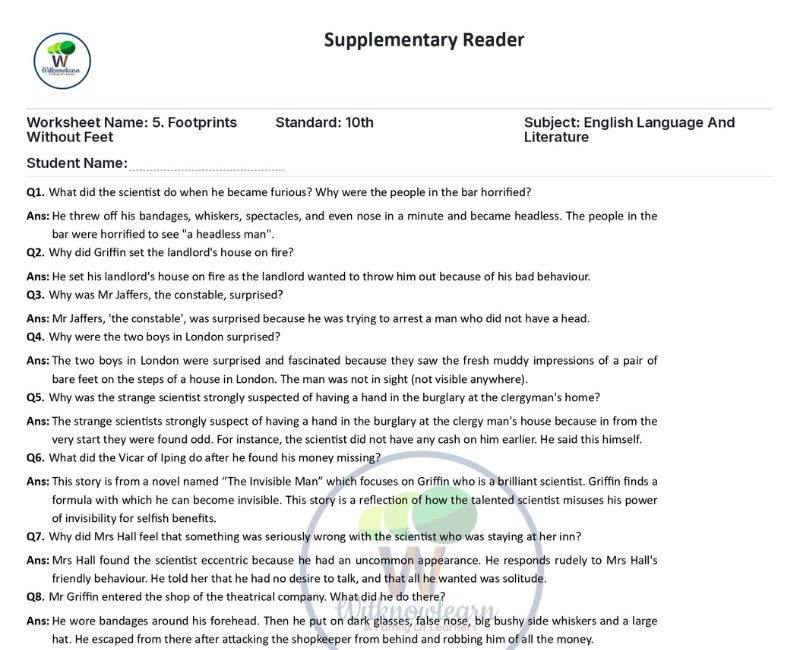
Visible footprints suggest an invisible presence, setting up an unusual mystery. Explore H. G. Wells’s story through WitKnowLearn’s Footprints Without Feet Class 10 worksheet with answers.
Practise tracing events, interpreting Griffin’s behaviour and explaining how mystery develops. Attempt the questions independently, then review the evidence and reasoning behind your responses.
Study Griffin’s Story through Questions
This worksheet page focuses on the chapter about Griffin, the invisible scientist, within the supplementary reader of the same name. Reading carefully helps you distinguish his scientific achievement from the choices he makes afterwards.
Follow the question-and-answer approach used across WitKnowLearn’s English worksheets. Complete factual tasks, extract-based activities, vocabulary questions and written responses before consulting the answers.
Keep your textbook nearby during the first attempt. Mark the detail supporting each answer, then revisit selected questions later without looking at the chapter. Check whether you can explain the significance of an event as well as recall it.
Footprints Without Feet Questions: Areas to Practise
Explain the Opening Mystery
For a question about the opening, separate what the observers can see from what they cannot explain. Identify the unusual detail and discuss how it encourages the reader to continue.
A focused response explains the effect of the scene. Avoid retelling later events when the task asks specifically how the mystery begins.
Track Visibility and Disguise
Pay attention to the distinction between Griffin’s body and the things he wears or carries. For questions about concealment, identify what makes his presence noticeable at that point.
Prepare a simple record of the situation, the problem and his response. This helps you explain why his extraordinary ability does not remove every practical difficulty.
Connect Actions with Consequences
For cause-and-effect questions, identify the choice Griffin makes and explain the problem that follows. Keep events from different settings in the correct sequence.
Choose details relevant to the instruction. If asked why he moves or changes his appearance, explain the immediate reason rather than giving a complete character sketch.
Examine the Reactions of Other Characters
When discussing the people Griffin encounters, consider what they know and what remains hidden from them. Their reactions can reveal how the mystery appears from another viewpoint.
Distinguish an observer’s interpretation from the explanation available to the reader. This gives your response greater accuracy, especially in questions about apparently supernatural incidents.
Evaluate Scientific Ability and Conduct
For a character-based response, examine intellectual ability and behaviour separately. Support each judgement with a specific action or detail.
If the question asks whether Griffin uses his discovery responsibly, develop your answer through the chapter’s events. Explain the relationship between his power and the way he treats others.
Original Practice Prompt
Question: How can an extraordinary ability create difficulties as well as advantages?
Answer approach: Identify one advantage Griffin gains, select a difficulty he still faces and explain the contrast using details from the chapter.
After writing, check whether both sides of the question are addressed. Your explanation should connect the examples rather than present them as unrelated facts.
Footprints Without Feet Extract-Based Questions
For Footprints Without Feet extract-based questions, identify the setting, the action described and whose perspective shapes the passage. Then examine the detail required by the task.
An extract may test reference, vocabulary, inference or character understanding. Use your knowledge of the chapter to establish context, while keeping the supplied passage central to your answer.
A Four-Step Reading Routine
- Locate the scene: Identify where the event occurs in Griffin’s journey.
- Check what is known: Separate the characters’ observations from the reader’s understanding.
- Select the evidence: Find the expression or action relevant to the question.
- Explain the connection: Show how the detail supports your response.
For MCQs, compare every option with the passage. For True or False tasks, locate the evidence that confirms the statement or shows which detail needs correction.
Organise Your Worksheet Practice
| Practice Area | Skill to Develop | Self-Check |
|---|---|---|
| Opening scene | Explaining mystery | Have you identified what makes the observation unusual? |
| Sequence of events | Accurate recall | Have you matched each event to the correct setting? |
| Visibility and disguise | Following the story’s logic | Have you distinguished Griffin’s body from external objects? |
| Character questions | Evaluating behaviour | Does each judgement have supporting evidence? |
| Extract-based tasks | Close reading | Does the passage support your interpretation? |
| Theme-based responses | Connecting ideas | Have you explained how the events develop your main point? |
Explain Suspense through the Reader’s Experience
For suspense questions, examine how information is introduced. Identify what seems puzzling, which explanation is delayed and how a later detail changes the reader’s understanding.
Select a particular moment and describe its effect. A response becomes more convincing when it explains why the scene creates curiosity or tension.
When discussing the title, connect its striking image with the opening situation and the discovery that makes it possible. Show why the phrase suits this chapter rather than treating it only as the name of the book.
Write Clear Short and Extended Answers
For Footprints Without Feet short questions and answers, begin with the requested information. Add the relevant evidence and explain it briefly, following any word limit provided.
For a character sketch of Griffin, choose a few qualities and support each through his actions. Explain contradictions where necessary instead of describing him through one broad label.
For Footprints Without Feet long-answer questions, plan your main claim and two supporting points. Organise the response around the question, whether it concerns mystery, power, judgement or responsibility.
Review Details before Expanding Your Answer
Check names, settings and the sequence of incidents. Make sure your response distinguishes the story’s fictional explanation from what its characters initially believe.
Compare your answer with the provided response for accuracy, relevance and reasoning. Rewrite one unclear explanation, then apply the improvement to another task.
Related Class 10 English Practice
Explore The Midnight Visitor worksheet with answers to practise explaining how incomplete information and unexpected revelations create suspense.
Use A Question of Trust worksheet for further practice in comparing a character’s abilities with the quality of their judgement.
FAQs about Footprints Without Feet Class 10
Who wrote the chapter Footprints Without Feet?
H. G. Wells wrote the story about Griffin. It appears in the Class 10 supplementary reader with the same title.
Who is Griffin?
Griffin is a scientist who discovers a way to make his body invisible but uses his ability for dishonest and violent purposes.
Why do the boys see footprints without visible feet?
Griffin’s invisible bare feet leave muddy impressions as he walks, so the boys see the marks without seeing the person making them.
Why does Griffin become a homeless wanderer?
After setting fire to his landlord’s house in revenge, he removes his clothes to escape unseen and begins wandering without shelter.
Why does Griffin go to Iping?
He seeks a quiet place away from London and takes a room at the village inn.
Why does Mrs Hall find her guest unusual?
His covered appearance, unfriendly manner and insistence on privacy make him seem strange to her.
What happens when Jaffers tries to arrest Griffin?
Griffin removes his clothes, becomes invisible and attacks those trying to restrain him, knocking Jaffers unconscious.
What theme can students discuss in the chapter?
The chapter invites discussion of responsibility: scientific brilliance does not excuse the harmful use of knowledge or power.
 Download