Rearranging Sentences Class 10 Worksheet with Answers
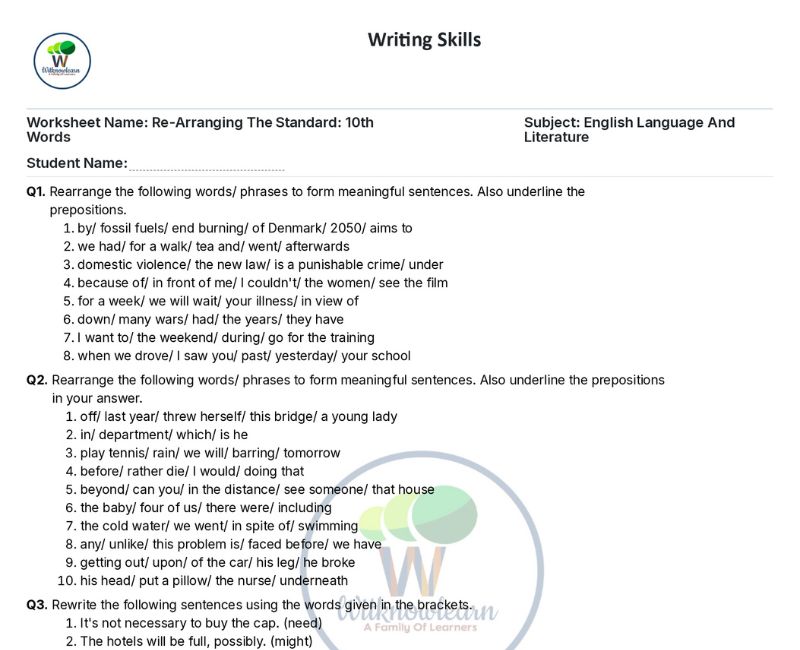
Turn jumbled words and phrases into clear, meaningful sentences with WitKnowLearn’s rearranging sentences Class 10 worksheet with answers. This resource offers 70 exercises and an answer sheet for focused English practice.
Work out the sentence structure, arrange the supplied parts and check your response. Each attempt gives you an opportunity to understand how word order shapes meaning.
Build Confidence in Sentence Construction
A sentence rearrangement task asks you to place given words or phrases in a suitable order. You need to consider grammar and meaning together: which words form a group, where the verb belongs and how the sentence expresses a complete idea.
This worksheet supports general Grade 10 English practice across school boards. Use it alongside your classroom lessons to develop accuracy in sentence construction and become more attentive to word order.
Attempt the exercises before opening the answer sheet. When reviewing, explain why the arrangement works. Understanding the structure helps you handle a new question independently.
How to Rearrange Jumbled Sentences
Find the Main Verb or Verb Group
Begin by identifying the action or state expressed. Check whether an auxiliary belongs with the main verb, as in “has completed” or “was reading.” Keep related verb forms together.
The verb group provides a useful starting point for the rest of the sentence. Ask who or what performs the action, and whether the verb requires an object or complement.
Identify the Subject
Look for the person, thing or idea that the sentence is about. In a typical statement, the subject comes before the verb. Check whether the subject and verb fit together.
Do not assume that the first item in the jumble must begin the answer. Consider the role of each part before choosing the opening.
Keep Meaningful Groups Together
Articles, adjectives and nouns often form a unit, such as “a useful guide.” Prepositions also introduce groups, such as “near the station” or “after the lesson.” Recognising these units reduces the number of arrangements you need to test.
If the question supplies phrases separated by slashes, follow its instructions about using those groups. Preserve the supplied wording unless a change is specifically allowed.
Recognise the Sentence Type
A statement, question and command can require different patterns. A question word or auxiliary may indicate that the answer should be interrogative. A command commonly begins with the base form of a verb.
Use all the clues together. Once you have a possible arrangement, check whether it expresses the sentence type suggested by the supplied words.
Place Additional Details Carefully
Expressions of time, place and manner add information to the main structure. Consider where they fit naturally and whether their position changes the meaning.
Some details can appear in more than one position. Judge the complete sentence for clarity rather than applying one word-order pattern to every exercise.
Original Worked Example
Jumbled parts: after lunch / the students / in the courtyard / gathered
Possible answer: The students gathered in the courtyard after lunch.
How to solve it: “The students” is the subject, and “gathered” is the verb. The remaining phrases explain where and when the action happened.
Another natural arrangement: After lunch, the students gathered in the courtyard.
Both versions use the supplied parts and express the same event. Check any additional instruction before choosing your final arrangement.
Sentence Reordering Practice Examples
The following original examples illustrate useful structures for jumbled sentences Class 10 practice. Try arranging each set yourself before reading the answer.
| Jumbled Words or Phrases | Possible Answer | Structure to Notice |
|---|---|---|
| the librarian / on the shelf / placed / the books | The librarian placed the books on the shelf. | Subject, verb, object and place |
| your project / have / completed / you | Have you completed your project? | Auxiliary before the subject in a question |
| before leaving / switch off / please / the lights | Please switch off the lights before leaving. | A request using the base verb form |
| because / we stayed indoors / it was raining | We stayed indoors because it was raining. | A main clause linked to a reason |
| to the museum / the visitors / by the guide / were welcomed | The visitors were welcomed to the museum by the guide. | A passive verb group |
Use Grammar Clues to Solve Longer Questions
For longer sentence reordering exercises for Class 10, work with smaller groups first. Identify the main clause, then connect any clause introduced by words such as “because,” “although” or “when.”
Read the relationship between the ideas carefully. One part may give a reason, introduce a contrast or explain when an event occurred. The connector helps you determine how the parts belong together.
Check word order inside each clause as well as the order of the clauses. A sentence can have a sensible overall sequence while still containing an incorrectly arranged verb group.
Check That Every Supplied Part Is Used
After constructing your answer, compare it with the original jumble. Mark each word or phrase as you use it. Look for an item accidentally omitted or repeated.
Avoid adding words simply to make your first arrangement work. Reconsider the order of the supplied parts and follow the question’s instructions. If a phrase seems difficult to place, examine its grammatical role.
A Quick Checking Routine
- Read the complete answer for meaning.
- Check the subject and verb group.
- Confirm that all supplied parts have been used correctly.
- Review articles, prepositions and connecting words.
- Add suitable capitalisation and punctuation.
Read the sentence aloud when practising at home. An awkward phrase may become easier to notice, but confirm your correction through the grammar and intended meaning.
Learn from the Answer Sheet
Use the answers to understand sentence patterns. If your response differs, compare the meaning, grammar and use of the supplied words. Some arrangements allow a natural alternative, particularly in the position of time or place phrases.
For an incorrect answer, identify the exact difficulty. Did you separate a verb group, misplace an article or arrange a reported clause as a direct question? Write the corrected sentence and explain the change briefly.
Keep a record of recurring errors. Practise one similar example after each correction so that you can test whether you have understood the pattern.
Make the 70 Exercises Part of Your Revision
Divide the worksheet into manageable sets. Complete a short set carefully, review it and choose one structure to practise again. Once your answers become more reliable, introduce timed sessions.
Teachers can ask students to compare arrangements and justify their choices. Pair discussion works especially well when learners explain which words form a phrase and how the sentence expresses its main idea.
Continue Your Class 10 English Practice
Explore the Do As Directed Class 10 English grammar worksheet to practise changing sentence structures according to specific instructions.
Use 100 unseen passages for Class 10 with answers PDF to observe word order in context and develop clear written responses.
FAQs about Rearranging Sentences Class 10
What is sentence rearrangement?
It involves arranging supplied words or phrases to form a meaningful, grammatically correct sentence.
How do I start solving a jumbled sentence?
Identify the verb group and its subject. Then connect the remaining phrases according to their meaning and grammatical function.
What is the difference between sentence and paragraph rearrangement?
Sentence rearrangement orders words or phrases within a sentence. Paragraph rearrangement orders complete sentences to create a connected passage.
Can I add extra words to my answer?
Follow the instruction. In a task asking you to rearrange the supplied words, use those words without adding or removing items unless permitted.
Can a jumbled sentence have more than one correct answer?
Sometimes. Certain phrases can appear in different positions. An alternative should remain grammatical, retain the intended meaning and satisfy the instruction.
How do I recognise a question in jumbled words?
Look for question words or auxiliaries and test whether they form a question with the remaining parts. Check the complete structure before adding a question mark.
Is this worksheet useful for Grade 10 students across boards?
Yes. It can support general English grammar practice. Students and teachers can select exercises relevant to their learning goals.
How can I improve my sentence reordering accuracy?
Practise identifying phrase groups, explain your corrections and check every supplied word. Revisit difficult patterns before increasing your speed.
 Download