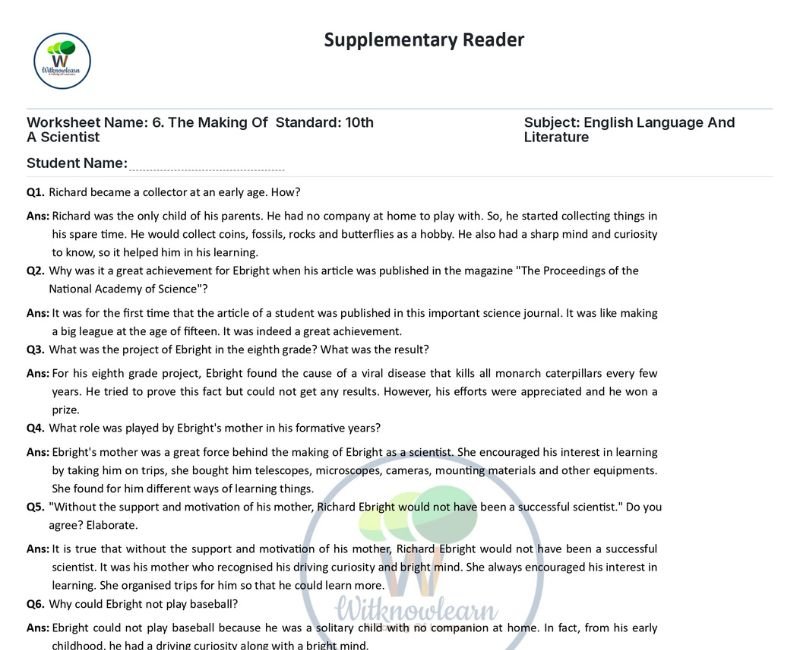
The Making of a Scientist Class 10 Worksheet with Answers
How does an interest in collecting grow into a habit of asking and testing questions? Explore Richard Ebright’s development through WitKnowLearn’s The Making of a Scientist Class 10 worksheet with answers.
Practise connecting experiences with qualities, explaining the purpose of experiments and writing evidence-based responses. Attempt the questions independently, then review how clearly your answers explain the steps in Ebright’s growth.
Read the Chapter as a Story of Development
Robert W. Peterson’s chapter follows a learner whose interests develop through encouragement, setbacks and investigation. For literature questions, focus on how an experience influences the person rather than remembering achievements as isolated facts.
Follow the question-and-answer approach used across WitKnowLearn’s English worksheets. Complete factual tasks, extract-based activities, vocabulary questions and written responses before consulting the answers.
Keep the textbook nearby during your first attempt. Mark the evidence supporting each response, then revisit selected questions later without looking at the chapter. Check whether you can explain why a detail matters as well as recall it.
The Making of a Scientist Questions: Areas to Practise
Connect Childhood Interests with Later Skills
When a question asks about early interests, identify the activity and explain the habit it develops. Consider observation, attention to detail or willingness to investigate.
A focused answer connects the childhood experience with the chapter’s larger account of growth. Avoid listing hobbies without explaining their relevance to the question.
Explain the Role of Encouragement
For questions about Ebright’s mother, choose specific examples of support and discuss their effect. Distinguish the resources she provides from the encouragement that helps him use them.
Organise the response around action and influence. This helps you explain a relationship rather than producing a list of things given to him.
Distinguish a Collection from an Investigation
A question about scientific learning may ask you to explain the difference between displaying material and testing an idea. Identify what makes the activity an investigation: a question, a method and evidence.
Use the chapter’s experience to explain the distinction. Show what Ebright learns and how it changes the way he approaches later work.
Describe Experiments through Their Purpose
For an experiment-based question, begin with what Ebright wanted to find out. Then describe the relevant approach and result at the level required by the task.
Keep the investigations separate in your rough work. A simple record of question, method and finding helps prevent details from different projects becoming mixed together.
Interpret Persistence and Competition
When discussing persistence, identify a difficulty or disappointing result and explain the response that follows. The response is what demonstrates the quality.
For a question about competition, examine how the chapter presents the desire to do well. Support your interpretation with the relevant description instead of assuming that every kind of competitiveness has the same meaning.
Original Practice Prompt
Question: How can a disappointing experience become useful to a learner?
Answer approach: Identify the experience, explain what Ebright learns from it and connect that lesson with a later change in his work.
After writing, underline the sentence that shows the connection between setback and improvement. Add an explanation if your answer only mentions the two events.
The Making of a Scientist Extract-Based Questions
For The Making of a Scientist extract-based questions, identify the stage of Ebright’s development described in the passage. Decide whether the focus is an influence, an investigation, a result or a personal quality.
An extract may test reference, vocabulary, inference or understanding of cause and effect. Read the instruction before choosing evidence. Use the supplied passage for the immediate response and the wider chapter to establish context.
A Four-Step Extract Routine
- Locate the stage: Identify where the experience belongs in the account.
- Recognise the task: Decide whether you need to recall, explain, infer or select an answer.
- Find the evidence: Choose the detail directly related to the question.
- Explain its significance: Show what it reveals about learning or development.
For MCQs, compare all options with the passage. For True or False tasks, locate the evidence that confirms the statement or shows which detail needs correction.
Organise Your Worksheet Practice
| Practice Area | Skill to Develop | Self-Check |
|---|---|---|
| Early interests | Connecting experiences with skills | Have you explained why the activity matters? |
| Family and guidance | Explaining influence | Have you connected support with its effect? |
| Science fair experience | Interpreting a turning point | Have you explained the lesson learned? |
| Investigations | Following purpose and evidence | Have you kept different projects distinct? |
| Character-based questions | Supporting qualities with actions | Does each judgement have an example? |
| Theme and title | Developing an interpretation | Have you shown how several experiences contribute to growth? |
Build a Character Sketch with Evidence
For a character sketch of Richard Ebright, choose a few qualities and support each with an experience. Explain how the evidence demonstrates curiosity, effort or another quality relevant to the question.
Consider the range of activities presented in the chapter when a task asks about his personality beyond scientific work. Select details that develop your answer instead of treating every interest as equally important.
A balanced response can connect individual effort with guidance and opportunity. Explain how these elements work together in the account of his development.
Explain the Title through the Learning Process
For a title-based question, focus on the idea of “making.” Identify the experiences, habits and influences that contribute to the learner’s progress.
Choose two or three connected examples and explain what each adds. This produces a stronger response than stating that Ebright becomes successful without examining the process described.
Write Clear Short and Extended Answers
For The Making of a Scientist short questions and answers, begin with the requested point. Add a relevant detail and explain it briefly, following any word limit provided.
For The Making of a Scientist long-answer questions, plan a main claim and two supporting points. Organise the response around the question, whether it concerns encouragement, persistence, investigation or growth.
Check tasks with several parts carefully. A question asking about an experiment and its significance needs both. Use clear references so the reader can follow which project or experience you mean.
Review the Connection between Detail and Meaning
Compare your response with the answers for accurate details, relevant evidence and clear reasoning. Your wording can differ while expressing the same supported idea.
Choose one improvement for a weak answer: clarify the purpose of a project, identify the lesson learned or explain a quality more precisely. Rewrite that part before attempting another task.
Related Class 10 English Practice
Explore the Footprints Without Feet worksheet with answers to compare how scientific ability and its use are presented in different chapters.
Use The Thief’s Story worksheet for further practice in explaining how encouragement and opportunities to learn can influence a person’s choices.
FAQs about The Making of a Scientist Class 10
Who wrote The Making of a Scientist?
Robert W. Peterson wrote the chapter about Richard Ebright. It is studied in Footprints Without Feet.
How did Ebright’s mother support his interests?
She encouraged his curiosity, took him on trips and provided books and equipment that helped him explore his interests.
Which book helped introduce Ebright to scientific work?
The Travels of Monarch X encouraged him to study monarch butterflies and participate in tagging them for research.
What did Ebright learn from his first science fair?
He learned that a collection or display was insufficient: successful science projects required real experiments.
How did Dr Frederick A. Urquhart help him?
Urquhart’s guidance and suggested projects gave Ebright questions to investigate through his butterfly research.
What did Ebright investigate about the spots on monarch pupae?
His work showed that the spots were associated with a hormone necessary for the butterfly’s development.
Which qualities contribute to becoming a scientist in the chapter?
The account highlights curiosity, intelligence, sustained effort and a competitive spirit directed towards doing one’s best.
Why is The Making of a Scientist a suitable title?
It traces how interests, encouragement, setbacks and experiments gradually develop Ebright’s scientific abilities.
 Download