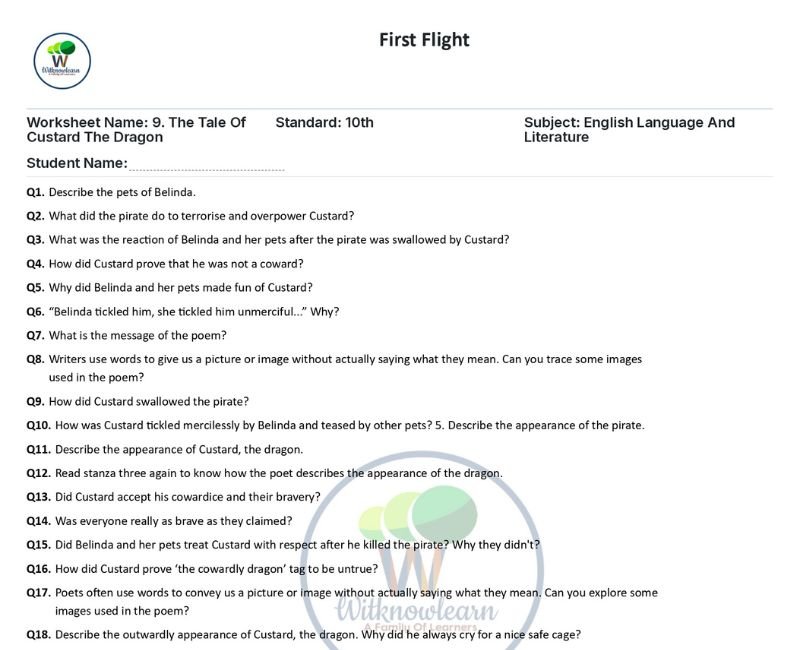
The Tale of Custard the Dragon Class 10 Worksheet with Answers
Who deserves to be called brave: the character who boasts or the character who acts when danger arrives? Explore this question through The Tale of Custard the Dragon Class 10 worksheet with answers.
Use the worksheet to practise close reading, character comparison, extract-based responses and explanations of humour. Attempt the questions independently, then review how well your answers connect ideas with evidence.
Practise Explaining the Poem’s Surprising Contrasts
Ogden Nash’s poem offers more than an entertaining story. Its contrasts give students opportunities to distinguish appearance from behaviour and claims from actions. A strong answer explains the contrast relevant to the question and supports it with a specific incident.
Follow the question-and-answer approach used across WitKnowLearn’s English worksheets. Work through factual questions, short and extended responses, extract-based activities and vocabulary tasks before consulting the answers.
Keep the textbook nearby during your first attempt. Mark the detail that supports each response. Later, try selected questions without referring to the poem and check whether you remember the evidence accurately.
Question Areas to Prepare
Character Descriptions and Behaviour
For a character-based question, separate physical description, what others say and what the character actually does. These categories help you build a balanced response instead of relying on a single label.
If the question asks for a character sketch, choose two or three qualities and support each with an action or detail. Avoid turning the answer into a list of adjectives without explanation.
The Difference between Reputation and Action
Practise comparing the characters’ earlier claims with their responses to danger. Organise your rough work into “before the incident” and “during the incident.” Then select the contrast that best answers the task.
For an interpretive response, explain what the comparison suggests. Your main idea should follow from the characters’ behaviour rather than from a general statement about bravery.
The Pirate Episode as a Turning Point
When answering a question about a turning point, identify the event that changes the situation and explain its significance. Choose the important actions rather than recounting every detail of the episode.
Check whether the question asks what happened, how a character reacted or why the event matters. Each instruction requires a different emphasis in your answer.
Humour and Exaggeration
For questions on humour, select a particular description, comparison or unexpected contrast. Explain what the reader expects and how the poem creates a comic effect.
A statement such as “the poem is funny” needs development. Show how the language or situation produces that impression. Keep your explanation connected to the example you have chosen.
The Ending and Its Effect
Read the ending carefully when preparing an answer about the poem’s message. Consider how it relates to earlier descriptions and what it adds to the reader’s understanding of the characters.
Try writing one sentence about the ending’s effect, followed by one supporting detail. This exercise helps you move from retelling to interpretation.
Original Practice Prompt
Question: How can a contrast between a character’s reputation and actions shape the reader’s judgement?
Answer approach: State the contrast directly. Choose an incident that demonstrates it, then explain how the action affects your view of the character.
After writing, underline your evidence and circle your interpretation. Check that the interpretation follows logically from the evidence.
The Tale of Custard the Dragon Extract-Based Questions
For The Tale of Custard the Dragon extract-based questions, begin with the passage supplied. Identify who is described, what is happening and which detail the question asks you to examine.
Use your understanding of the whole poem to establish context, then return to the extract for precise evidence. This helps you avoid writing a familiar summary when the task requires close attention to a particular phrase.
A Practical Extract Routine
- Read the instruction: Decide whether the task concerns recall, inference, vocabulary or a poetic device.
- Locate the relevant detail: Select the action, description or expression that supports your response.
- Explain the connection: Show how that detail answers the question.
- Check accuracy: Confirm names, references and the sequence of events.
For MCQs, compare all options with the passage. For True or False tasks, locate the detail that confirms the statement or shows what needs correction.
Organise Your Worksheet Practice
| Question Area | Skill to Develop | Useful Self-Check |
|---|---|---|
| Names and descriptions | Accurate recall | Have you matched each detail to the correct character? |
| Character comparison | Explaining contrasts | Have you discussed both characters using relevant evidence? |
| Extract-based MCQs | Close reading | Can you justify your choice from the passage? |
| Vocabulary questions | Understanding context | Does the meaning fit the surrounding description? |
| Humour and poetic devices | Explaining language | Have you identified an example and described its effect? |
| Extended responses | Developing an interpretation | Does each paragraph support your main idea? |
Explain Poetic Devices with Examples
When practising The Tale of Custard the Dragon poetic devices, read the expression supplied in the question. Identify the feature and explain what it contributes to the description, sound or humour.
For a comparison, identify the two things connected and the quality they share. For a sound-based feature, pay attention to how the words work when read aloud. For rhyme questions, examine the line endings rather than guessing from the poem’s lively pace.
Keep your answer focused on the requested example. A short explanation of one device is more useful than a list of terms with no supporting evidence.
Write Clear Short and Extended Answers
For short responses, begin with the requested point and add the detail needed to explain it. Follow the word limit provided and remove sentences that merely repeat your opening.
For The Tale of Custard the Dragon long-answer questions, plan a main claim and two supporting points. Explain each point through the poem’s events or language. Maintain a clear connection between your evidence and the question.
If a task asks you to compare humour across texts, choose a common basis, such as exaggerated behaviour or the gap between claims and actions. Include evidence from both texts and explain the relationship.
Use the Answers to Improve Your Reasoning
Compare your response with the provided answer for accuracy, relevance and explanation. Your wording can differ while communicating the same supported idea.
Identify one improvement for each weak response: a more direct opening, better evidence or a clearer explanation. Rewrite the necessary part, then apply the correction to another question.
Related Class 10 English Practice
Explore the How to Tell Wild Animals worksheet with answers for further practice in explaining exaggeration and comic descriptions.
Use The Proposal Class 10 worksheet with answers to practise comparing how dialogue and character behaviour create humour.
FAQs about The Tale of Custard the Dragon
Who wrote The Tale of Custard the Dragon?
Ogden Nash wrote the poem. It is studied in the Class 10 English textbook First Flight.
Who are Belinda’s pets?
Ink is a kitten, Blink is a mouse, Mustard is a dog and Custard is a dragon.
Why do the others call Custard a coward?
Custard repeatedly asks for a safe cage, which makes the others regard him as fearful and tease him.
How does Custard show courage?
When an armed pirate enters, Custard confronts and devours him, protecting the household while the others panic or hide.
What does the poem suggest about bravery?
It suggests that courage is demonstrated through action in danger. Boastful claims do not necessarily reflect how someone will behave.
How does the ending add humour?
The others resume claiming superior bravery, while Custard accepts their claims and still wants a safe cage. This return to the earlier pattern creates irony.
Why can the poem be described as a humorous ballad?
It tells a story through verse, with characters and a dramatic incident. Exaggerated descriptions and unexpected behaviour give the narrative a comic quality.
How should I revise the poem’s questions and answers?
Attempt factual, extract-based and interpretive tasks. Review your evidence, explain your corrections and practise writing a focused response without relying on memorised wording.
 Download