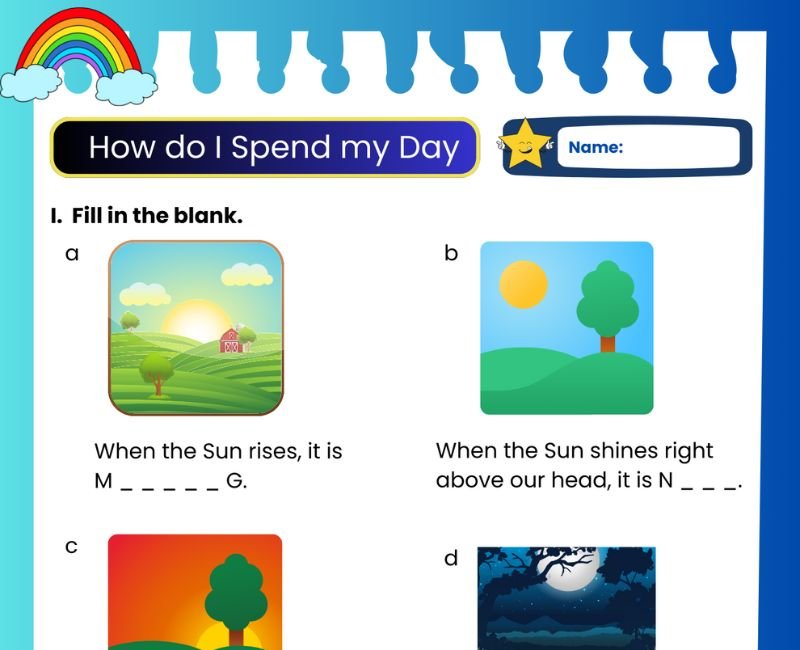
How Do I Spend My Day Class 1 Worksheet
Explore time through familiar activities with this How Do I Spend My Day Class 1 worksheet. Use it alongside NCERT Class 1 Maths Chapter 10 - How do I Spend my Day? (Time) in the Joyful Mathematics textbook.
Children connect morning, afternoon, evening and night with everyday routines. They also compare how long activities take and explore seasonal changes. The original activities and practice questions with answers below provide extra opportunities for discussion alongside the worksheet available on this page.
Recognise Morning, Afternoon, Evening and Night
Begin by asking children to describe their day. Waking up and eating breakfast are familiar morning activities for many children. Lunch often happens around midday or in the afternoon, while dinner and bedtime are commonly associated with night.
Use these examples as starting points rather than fixed rules for every family. School timings, meals and daily routines may differ. Ask children to explain when they do an activity in their own home.
Discuss clues in pictures, such as sunrise, sunset and people getting ready for bed. Use several clues together. The Moon can also be visible during the day, so it should not be treated as a sign that it must always be night.
Put Daily Activities in Order
Make picture cards showing waking up, getting ready, going to school, returning home and going to bed. Ask the child to arrange them in an order that fits a familiar school day.
Wake up, get ready, eat breakfast, go to school, return home, eat dinner, go to bed.
Use words such as first, next, before, after and last. Ask, "What happens before you leave for school?" and "What do you do after returning home?" Accept a different sequence when it accurately describes the child's routine.
Compare Longer and Shorter Durations
Time can describe how long an activity lasts. Saying one word takes less time than telling a complete story. A school day usually takes longer than tying a shoelace.
Choose clear examples and ask children to predict which takes longer. Then observe the activities where practical. Avoid assuming that every child takes the same amount of time to complete a task.
Keep the comparison concrete: "This activity took longer than that one." Precise clock calculations are not needed to begin understanding duration. Children can first recognise the difference through experience and explanation.
Explore Summer, Monsoon, Winter and Spring
The chapter also introduces summer, monsoon, winter and spring. Talk about familiar weather, clothing, foods and local observations associated with these seasons.
Children may connect hot summer days with light clothing, rainy monsoon days with raincoats and cold winter days with warm clothes. Spring can be discussed through new growth and flowering plants where these changes are noticeable.
Seasonal conditions vary across India. Use examples from the child's surroundings rather than assuming that every place experiences the same weather. A raincoat is useful when it rains, even if rain occurs outside the main rainy season.
Make a Personal Daily Routine Strip
Fold a sheet into four sections labelled morning, afternoon, evening and night. Invite the child to draw or paste one activity in each section and explain the choices aloud.
Add a simple sequence of three activities below the drawings. Ask the child to describe what happens first, next and last. This combines recognising parts of the day with ordering events.
For seasonal learning, make a separate page showing clothing or food the child associates with different seasons. Discuss the reasons for each choice. Open-ended drawings can have several sensible answers.
Original Chapter 10 Practice with Answers
Use these additional questions orally or in a notebook. For personal routine questions, sample answers are provided.
- Arrange these parts of the day: night, morning, evening, afternoon.
- Which comes after morning: afternoon or night?
- Which usually takes longer: saying one word or telling a complete story?
- Riya wakes up, gets ready and then leaves for school. What does she do just before leaving?
- Arun eats dinner and then goes to bed. What does he do after dinner?
- Which is useful on a rainy day: a raincoat or sunglasses?
- Which is suitable on a cold winter day: a woollen sweater or thin summer clothing?
- Name one activity you do in the morning.
- Name one activity you do at night.
- Do all families follow exactly the same daily routine?
Show Practice Answers
1. Morning, afternoon, evening, night
2. Afternoon
3. Telling a complete story
4. She gets ready
5. He goes to bed
6. A raincoat
7. A woollen sweater
8. Sample: eat breakfast; accept a suitable personal answer
9. Sample: go to bed; accept a suitable personal answer
10. No; routines may differ
How to Use the Class 1 Maths Time Worksheet
Use the worksheet download option on this page alongside the Joyful Mathematics textbook. Read instructions aloud when needed and invite children to describe the activities or weather clues they see.
Ask for an explanation rather than a one-word guess. When comparing durations, discuss what each task involves. When ordering activities, check the order against the routine described in the question.
Parents can use family routines, while teachers can use classroom events. The answers above apply to the original examples on this page; picture-based worksheet answers depend on the actual pictures shown. Personal routine and seasonal project tasks may have more than one appropriate response.
More NCERT Class 1 Maths Worksheets
Continue with these chapter-based Joyful Mathematics resources.
Chapter 7: Lina's FamilyExplore measurement and everyday comparisons. Chapter 8: Fun with Numbers
Practise numbers from 21 to 99. Chapter 9: Utsav
Recognise, continue and create patterns. Chapter 11: How Many Times?
Explore equal groups and early multiplication ideas.
Browse General and NCERT Grade 1 Maths Practice
Explore All Class 1 Maths WorksheetsFind general topic practice and NCERT chapter worksheets for further learning.
How Do I Spend My Day Class 1 FAQs
Which chapter is How Do I Spend My Day in Class 1 Maths?
How do I Spend my Day? is Chapter 10 of NCERT Joyful Mathematics. Its main theme is time.
What can children practise in this chapter?
They can recognise parts of the day, order daily activities, compare durations and discuss summer, monsoon, winter and spring.
Does this chapter focus only on reading clocks?
No. Its activities develop early understanding of time through routines, parts of the day, duration and seasons.
How do I teach before and after?
Use a familiar sequence. If a child gets ready and then leaves for school, getting ready happens before leaving.
How can children compare how long activities take?
Begin with clearly different tasks, such as saying one word and telling a story. Predict, observe and discuss which takes longer.
Are morning and night activities the same for every child?
No. Family routines and school timings differ. Accept answers that fit the routine described.
Does seeing the Moon always mean it is night?
No. The Moon can be visible during the day. Consider other clues when identifying the time of day.
Which seasons are discussed in the chapter?
The chapter discusses summer, spring, monsoon and winter. Use local examples to explain their differences.
Are answers available for the practice questions?
Yes. Expand Show Practice Answers to check the ten original examples, including sample responses for personal questions.
 Download