Addition Worksheets for Class 1
Three blocks joined with four more make seven blocks. This simple action helps children understand addition before they begin solving written sums. Pictures, counters and number lines give young learners different ways to explore the same idea.
Use these addition worksheets for Class 1 for classroom practice, homework or revision. The guidance and extra questions below support counting and adding, picture addition, number-line methods and early number facts. Choose activities that suit your child’s current understanding and encourage them to explain how they found each total.
Understanding Addition and the Plus Sign
Addition combines quantities to find a total. In 3 + 4 = 7, the plus sign (+) tells us to add three and four. The equal sign (=) shows that the expression on the left has the same value as the number on the right.
Read the sentence aloud as “three plus four equals seven.” Show it with two groups of counters, combine the groups and count the total. Connect each written number to the quantity it represents.
Count and Add with Pictures
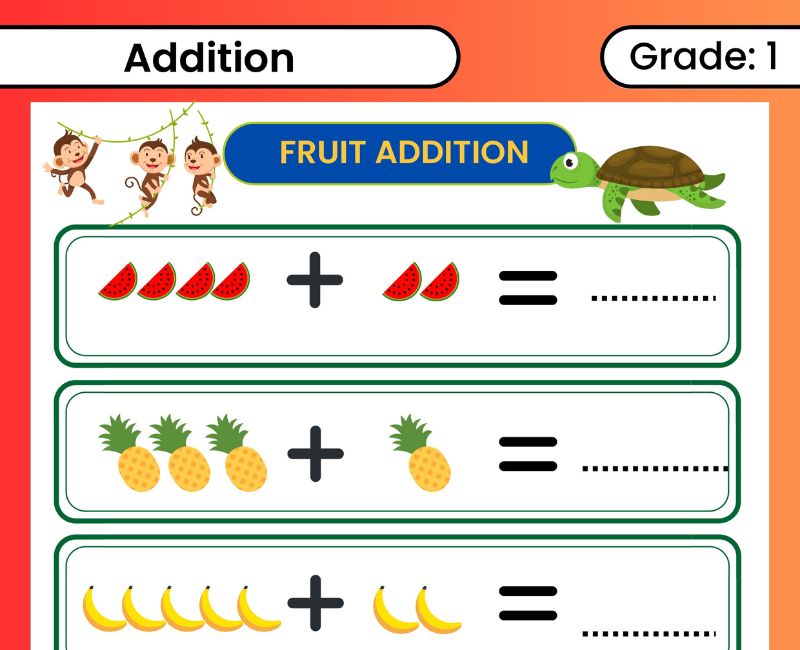
Picture addition helps children connect numbers with visible quantities. Count the objects in the first group, count the objects in the second group and then find the total. Point to each picture once to avoid missing or counting an object twice.
Worked example: Draw five circles in one group and two circles in another. There are seven circles altogether, so 5 + 2 = 7.
Children do not need detailed drawings. Simple circles or marks are enough to represent the quantities. Ask them to show which group represents each number in the sum.
Move from Counting All to Counting On
Counting all means starting at one and counting every object in the combined group. Counting on means keeping one quantity in mind and counting the additional objects.
For 6 + 3, begin with six and count three more numbers: seven, eight, nine. The answer is nine. Six is the starting quantity, so it is not counted as the first additional step.
When children understand both quantities, starting with the larger number can reduce the counting steps. To solve 2 + 8, they can start at eight and count nine, ten. Use objects to show why changing the order does not change the total.
Addition on a Number Line
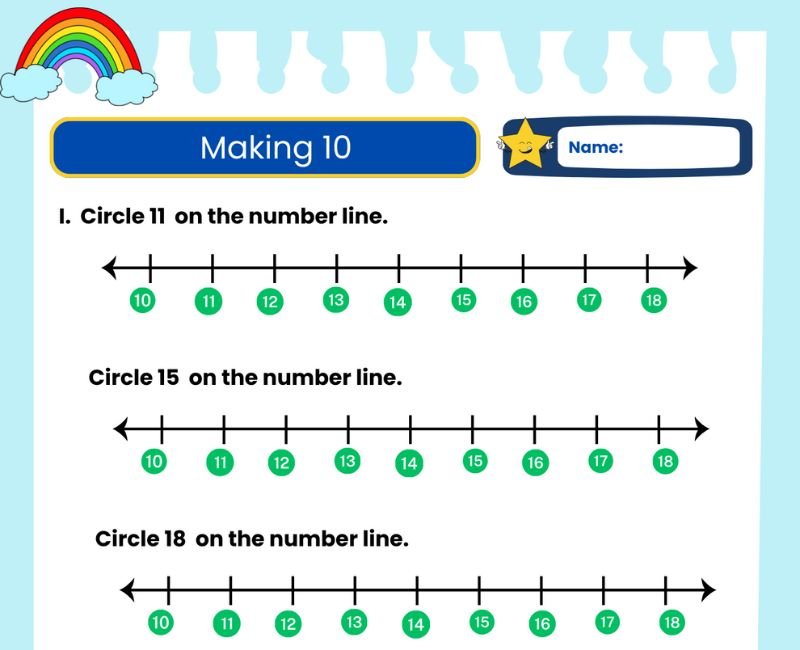
Use a number line with values increasing from left to right. For 4 + 3, start at four and make three jumps to the right, landing on five, six and seven. Therefore, 4 + 3 = 7.
Mark each jump and count the movements. If a child lands on six instead of seven, check whether they counted the starting position as a jump. A clear starting dot and separate jump marks can help.
Useful Addition Facts: Zero, Doubles and Making Ten
Adding zero leaves the quantity unchanged: 7 + 0 = 7. Doubles combine two equal quantities: 4 + 4 = 8. Show these facts with counters so children understand the relationship rather than memorising words alone.
Practise pairs that make ten, such as 6 + 4, 7 + 3 and 8 + 2. A ten-frame helps children see how many spaces remain after placing the first group.
As an extension, use ten to solve 8 + 5. Split five into two and three. Eight plus two makes ten, and ten plus three makes thirteen. Introduce this method when your child can confidently make ten.
Extra Addition Questions for Class 1 with Answers
These additional online questions include totals within twenty, missing addends and a short story sum. Use a drawing, counters or a number line when needed.
- 2 + 3 = ___.
- 5 + 4 = ___.
- 7 + 0 = ___.
- 4 + 4 = ___.
- 6 + 4 = ___.
- 8 + 3 = ___.
- 9 + 5 = ___.
- 10 + 7 = ___.
- 12 + 6 = ___.
- 15 + 5 = ___.
- 3 + ___ = 8.
- ___ + 4 = 10.
- Are 2 + 7 and 7 + 2 equal? Find both totals.
- A shelf holds 6 books. Four more books are added. How many books are on the shelf now?
View answers to the extra practice questions
1. 5; 2. 9; 3. 7; 4. 8; 5. 10; 6. 11; 7. 14; 8. 17; 9. 18; 10. 20; 11. 5; 12. 6; 13. Yes, both equal 9; 14. 10 books, because 6 + 4 = 10.
Colour-by-Addition and Number Puzzles
For a simple colour-by-addition activity, draw several sections and write one sum inside each. Create a key, such as “total 5: green” and “total 8: purple.” Children solve each sum before choosing the colour.
Another activity is to find different pairs that make the same total. Ask children to make eight using two groups of counters: one and seven, two and six, three and five, or four and four. Record each pair as an addition sentence.
Related Class 1 Maths Worksheets
Addition Word Problems Worksheet: Apply addition to short stories and everyday situations. Addition and Subtraction Worksheets: Practise both operations and their relationship. Numbers 1 to 20 Worksheet: Strengthen counting for early addition sums. Tens and Ones Worksheet: Build place-value understanding for two-digit numbers. Browse Class 1 Maths Worksheets: Find more activities for regular practice.Frequently Asked Questions
How do I introduce addition to a Class 1 child?
Combine two small groups of objects and count the total. Then write the matching addition sentence. Move from objects to drawings and written sums gradually.
What is picture addition?
Picture addition uses drawings to represent quantities being combined. Children count the pictured groups and find their total before writing the answer.
Why does my child get one less when counting on?
They may be counting the starting number as the first step. For 5 + 2, begin at five and count two additional numbers: six, seven.
Does changing the order of two numbers change their sum?
No. For example, 3 + 6 and 6 + 3 both equal nine. Swap two groups of counters to demonstrate that the total stays the same.
How can I help with a missing number addition question?
For 4 + ___ = 9, begin with four counters and add counters until there are nine. Five were added, so the missing number is five. Check the complete sentence: 4 + 5 = 9.
Are answers included for the extra addition questions?
Yes. Open the answer section beneath the additional questions in this description to check their corresponding answers.
 Download